

Streets of Heat & Motion: Downtown Houston Through Eastman Double X
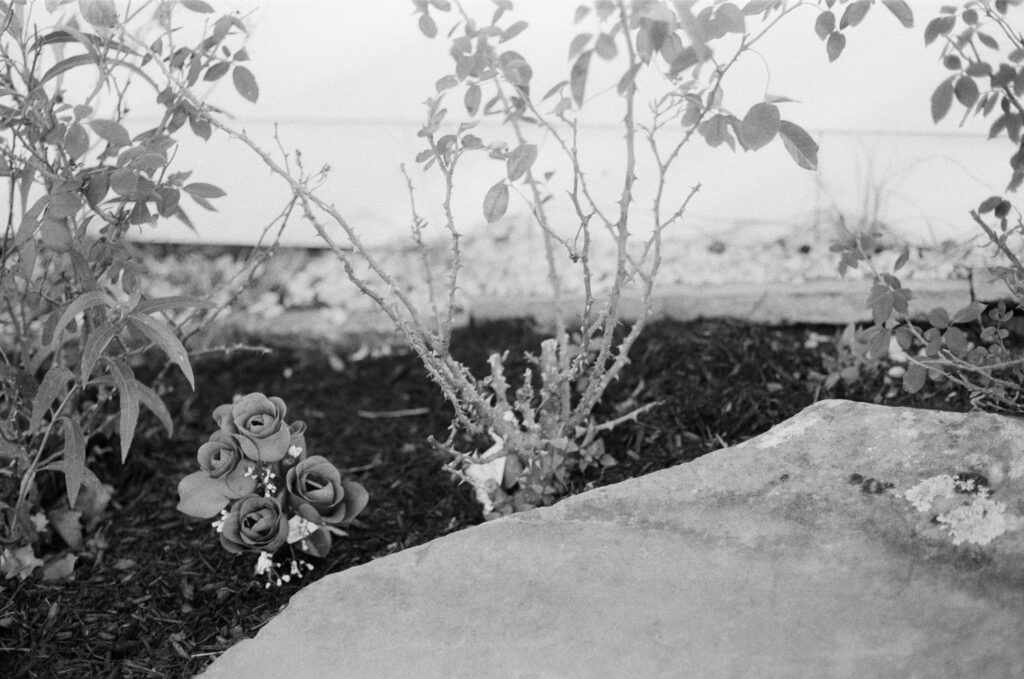
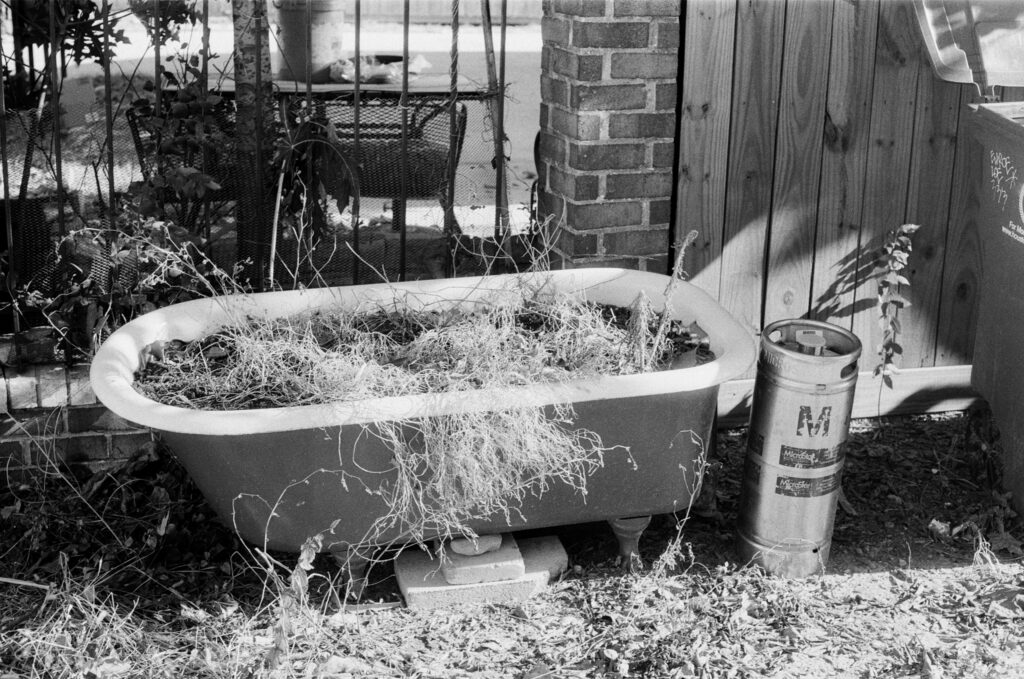
Shot with Canon AE-1 Program on FPP Eastman Double X black-and-white film, downtown Houston, TX.
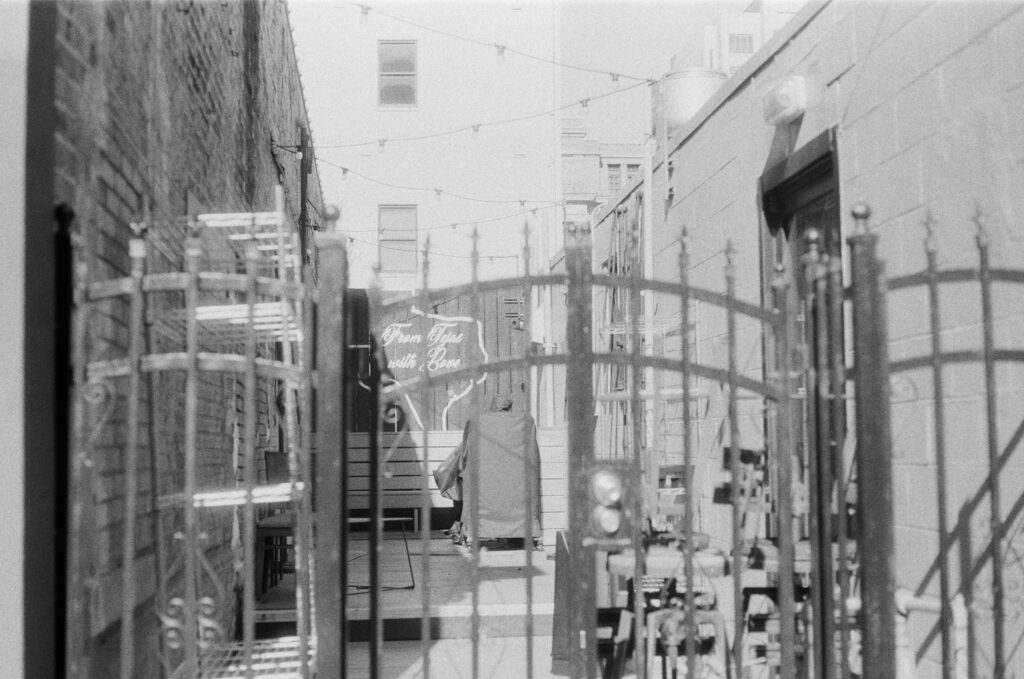
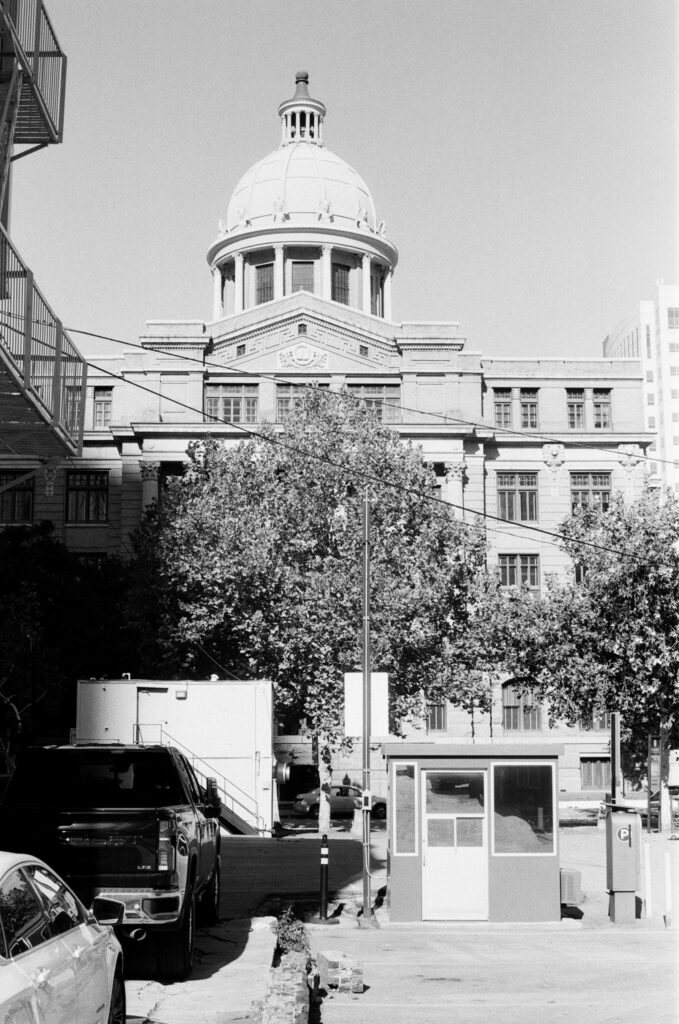

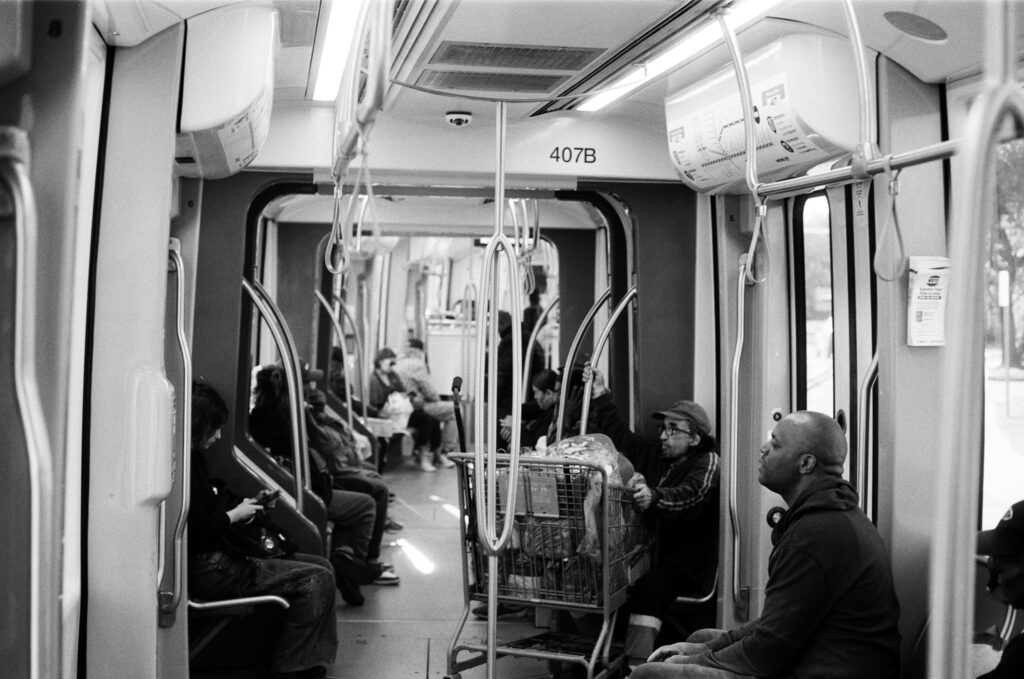
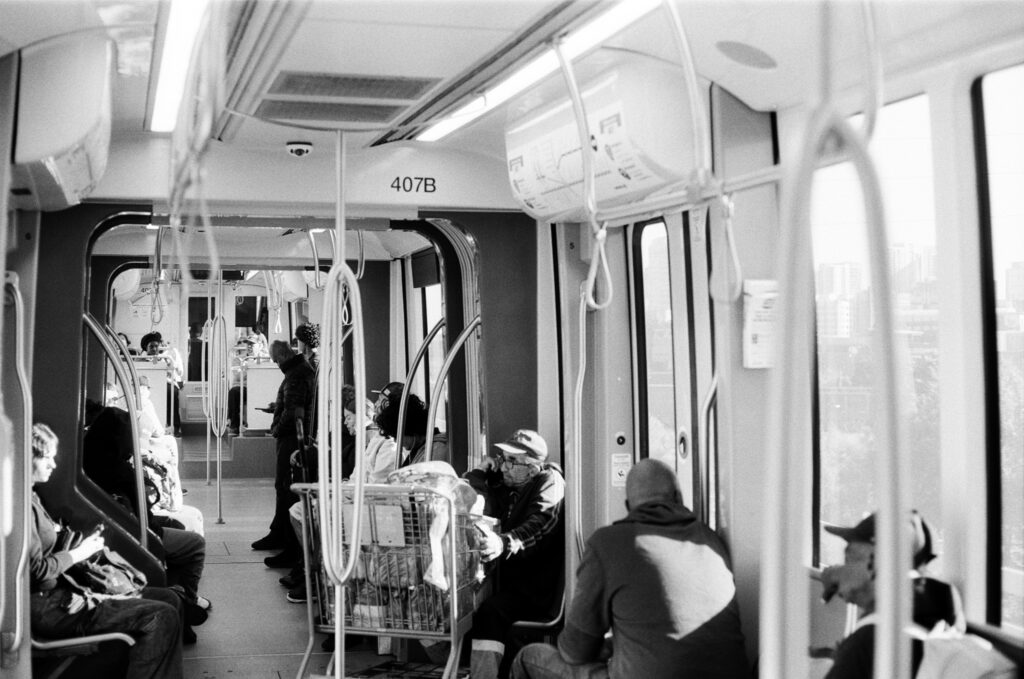
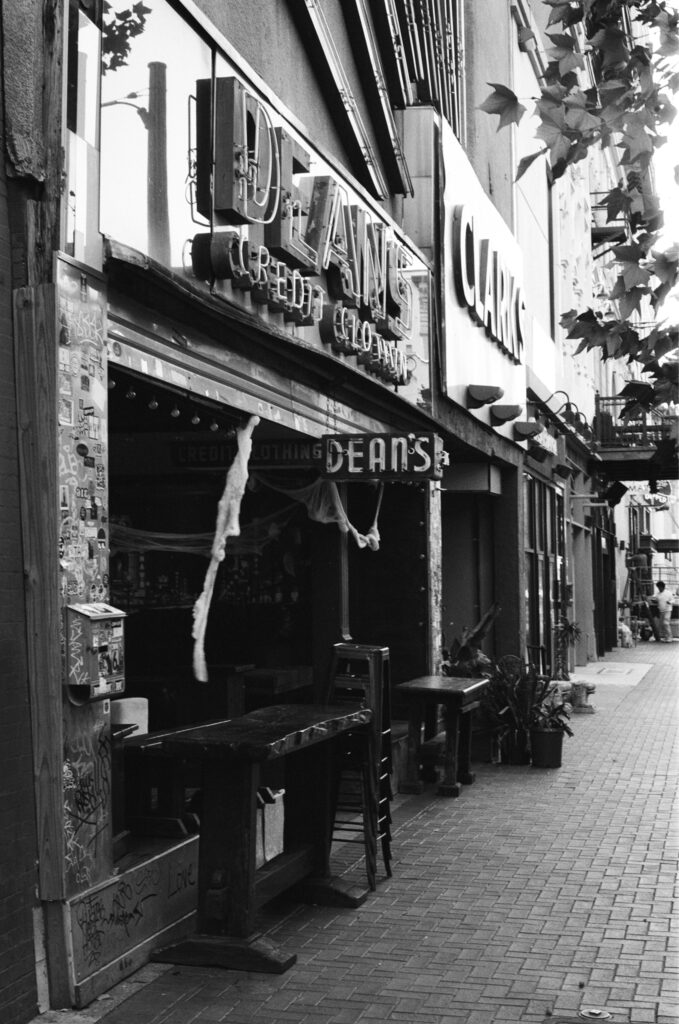
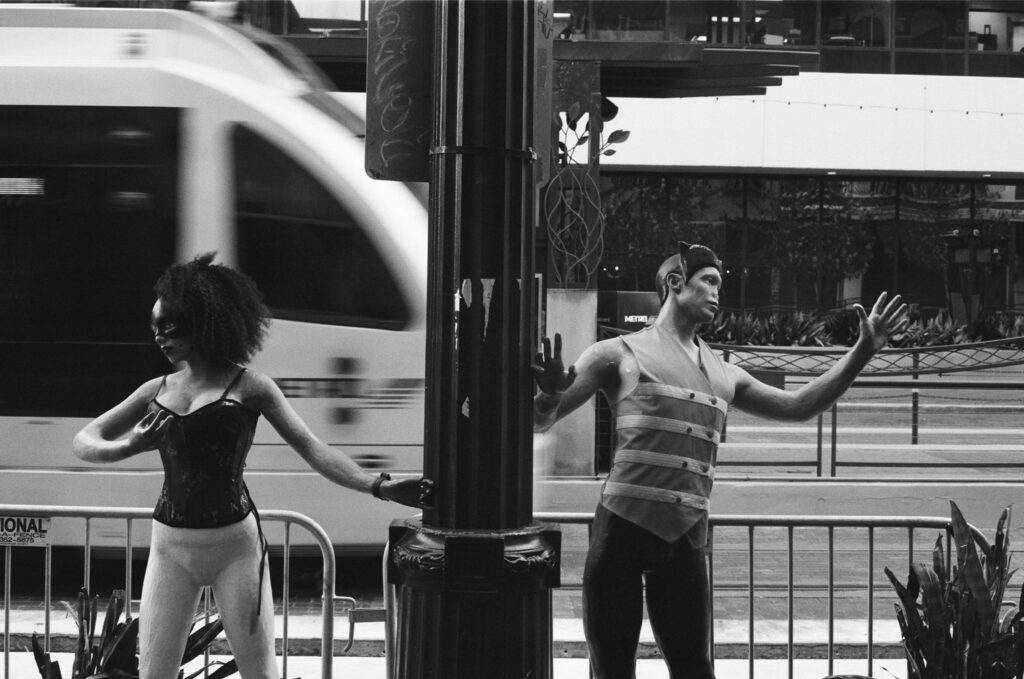
Observation at Speed
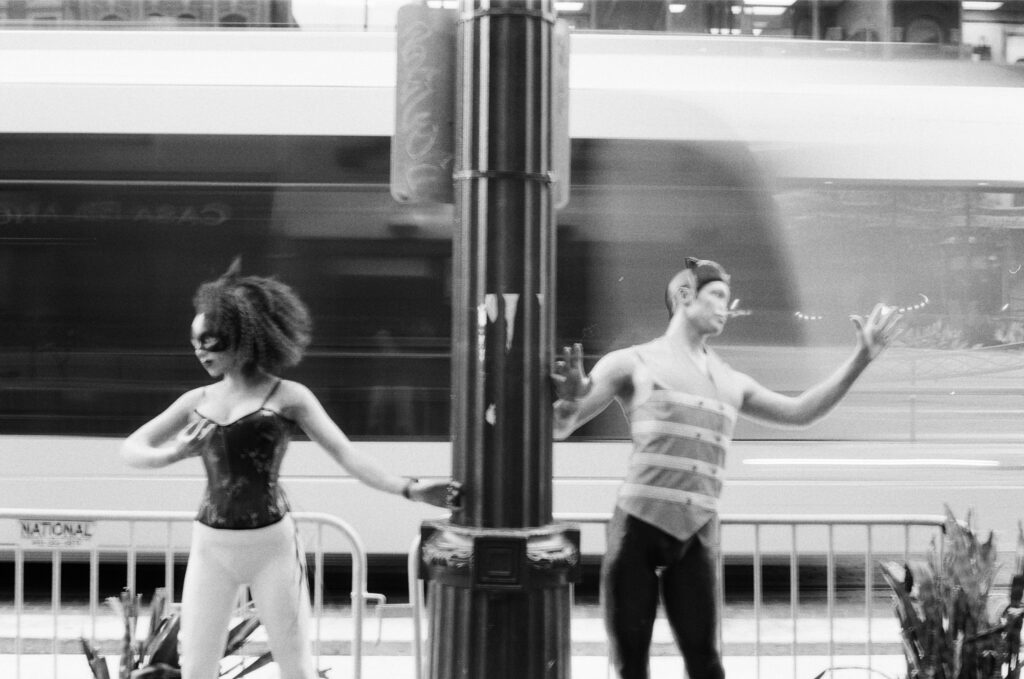
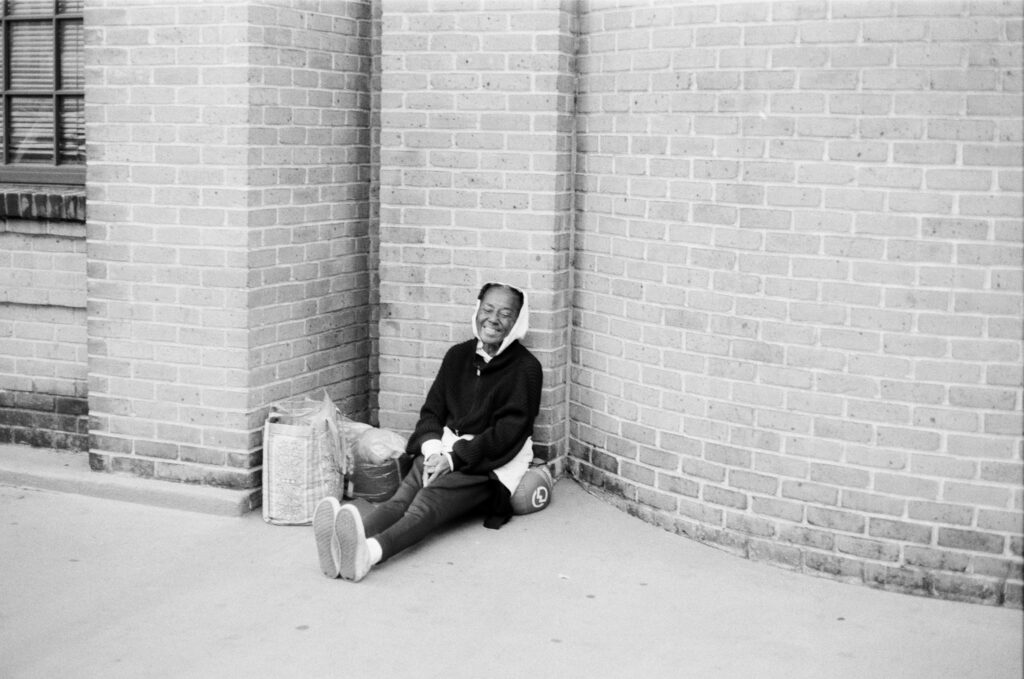
The downtown streets of Houston pulse with contradictions. Steel towers reflect midday sun while air-conditioning hums drown out voices below. Across sidewalks and alleyways a tapestry of humanity moves: office workers stepping from glass lobbies, street vendors balancing trays of snacks, an older man pushing a cart down Leeland Street, a group of migrant workers talking in Spanish under shade-trees.
Using the AE-1 Program and the rich, cinematic grain of Eastman Double X, I slowed just enough to capture frames like these—not as mere records, but as stories.
The Medium: Why Eastman Double X?
Eastman Double X is a black-and-white film with motion-picture lineage: deep, punchy blacks, luminous highlights, and texture that draws the eye. It’s an analogue choice for a world of gloss and blur. Shot at ISO 250 (or pushed to 400) it handles mixed daylight and deep shadow well—perfect for Houston’s downtown canyon of glass and concrete.
By pairing this with the Canon AE-1 Program, I retained a mechanical integrity—a body built when photos mattered and frames were precious. No bursts, no previews, no digital post-fade polishing—just shot, wind, record.
Frame by Frame: What the Street Told Me
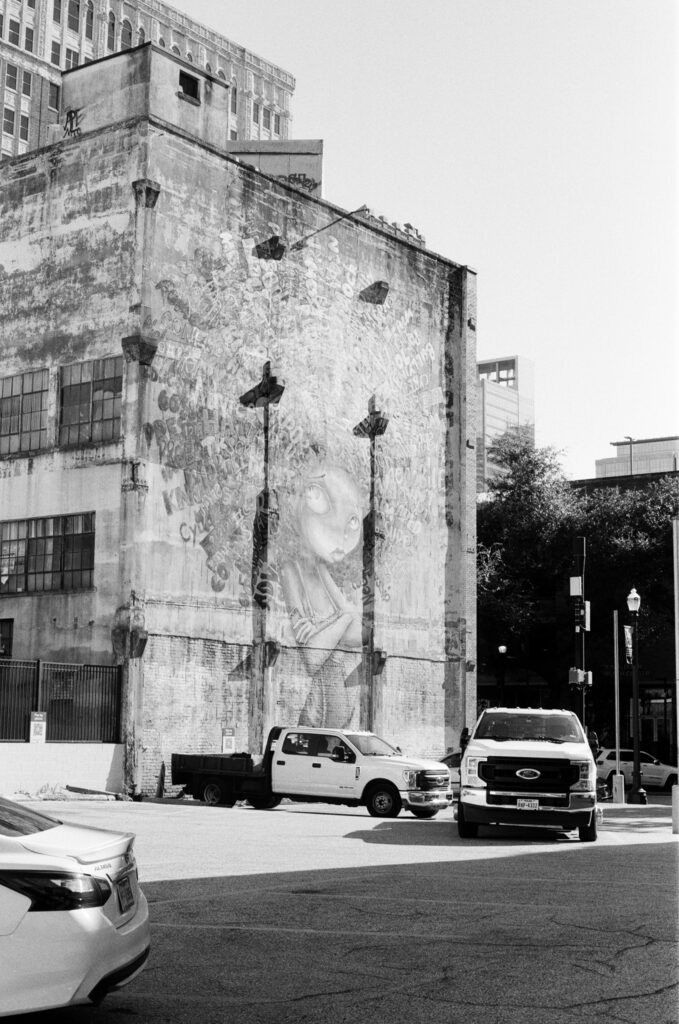
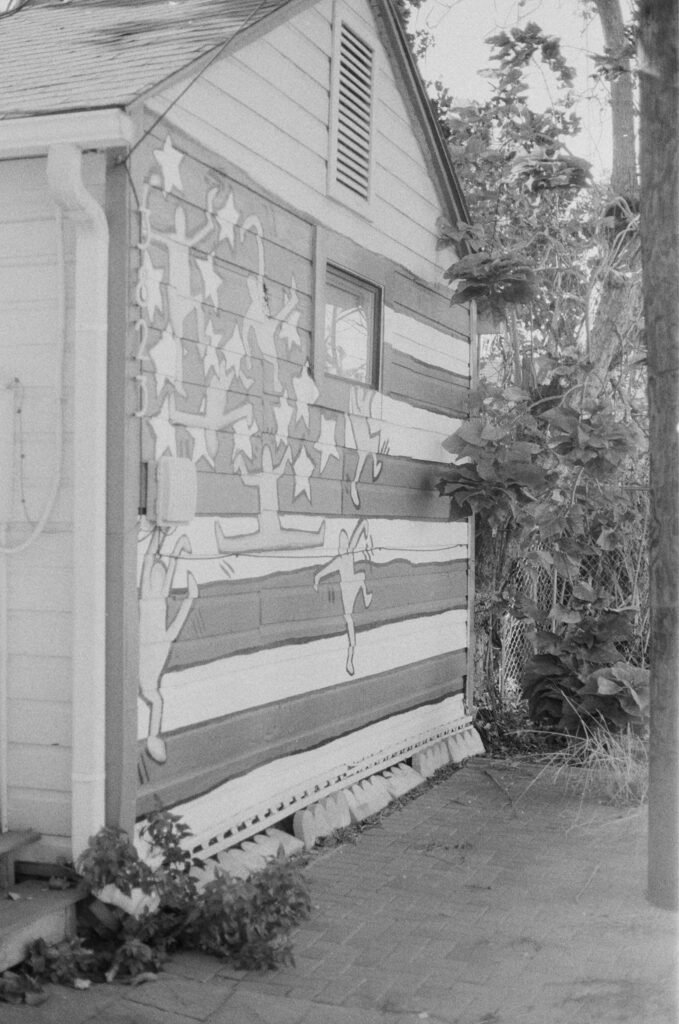
- A mural-covered industrial wall under the stark morning sun. Its visual layers—brick, graffiti, trucks parked—echo Houston’s layered history of industry.
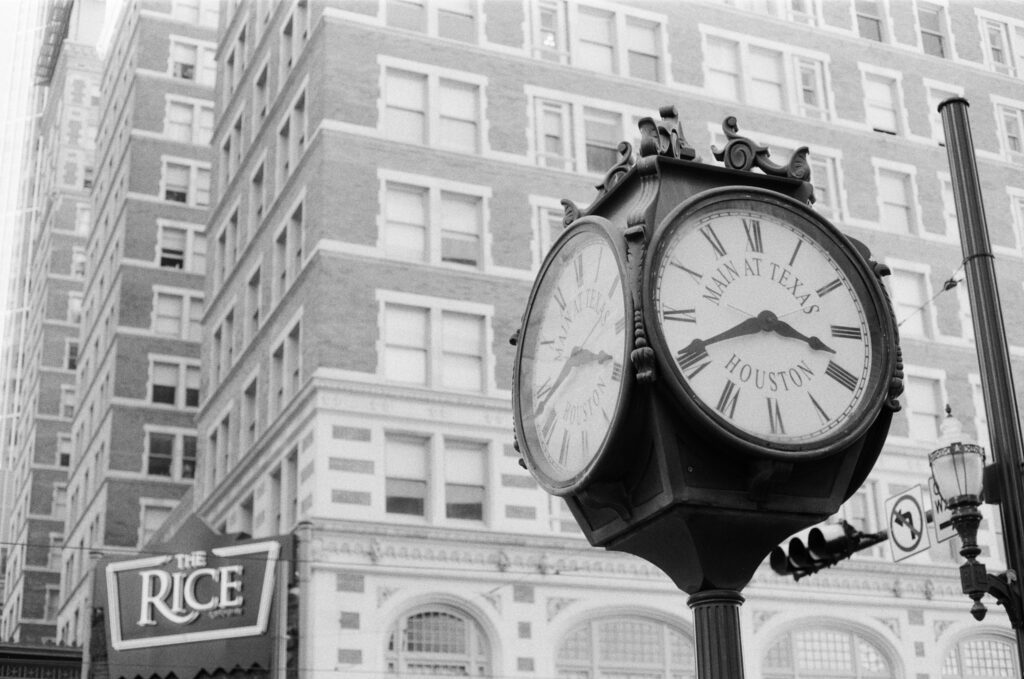
- A four-faced street clock reading midday; behind it a facade of early-20th-century architecture compressed by newer towers. Time and place colliding in one still.
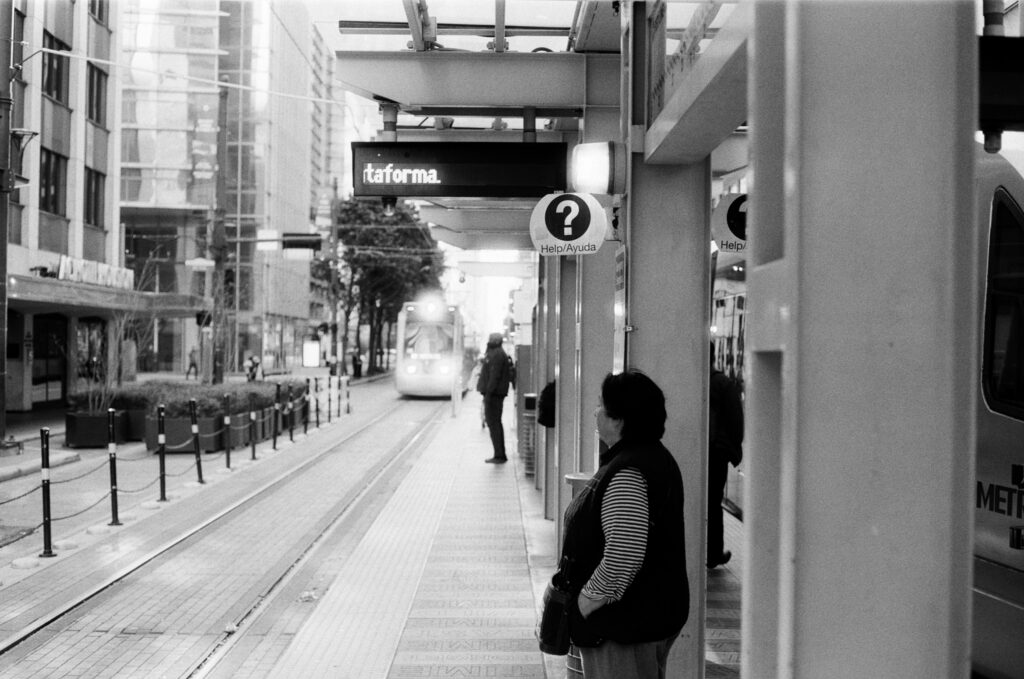
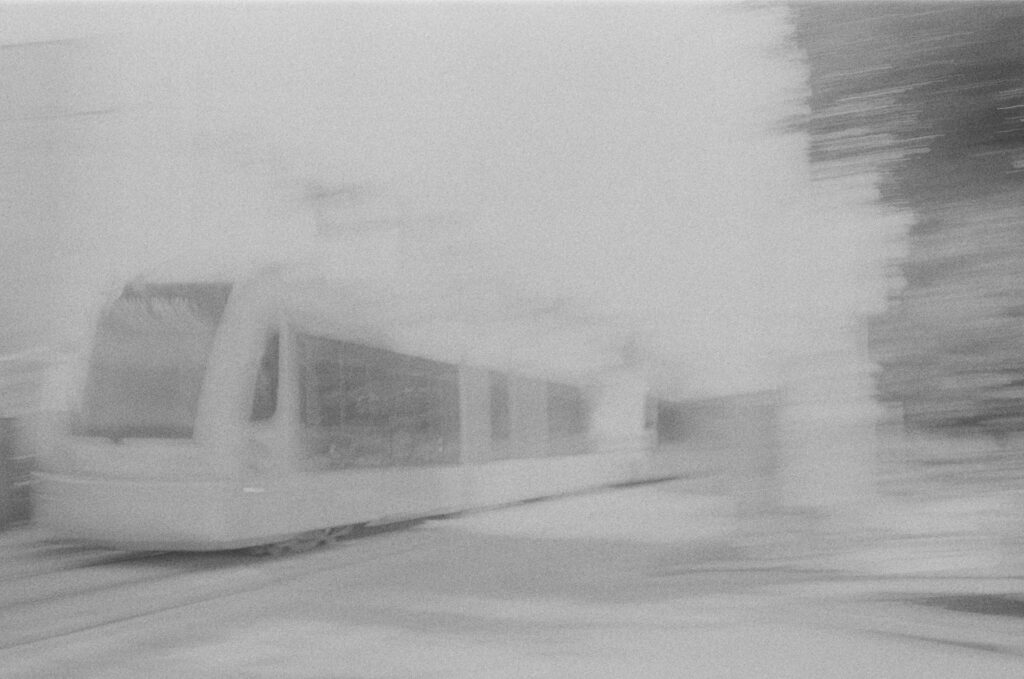
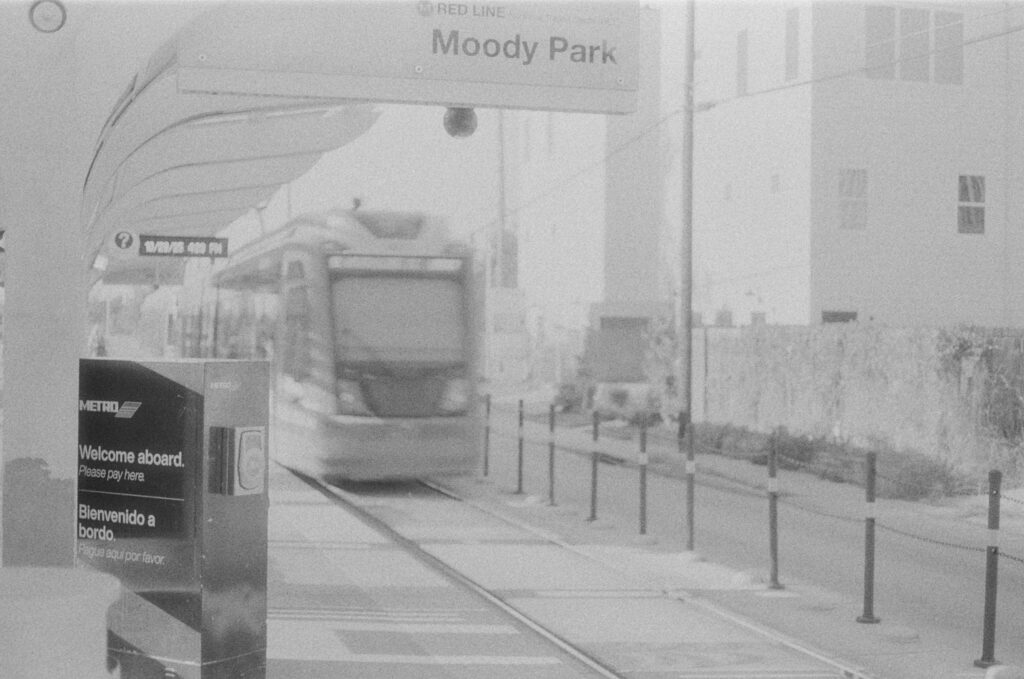
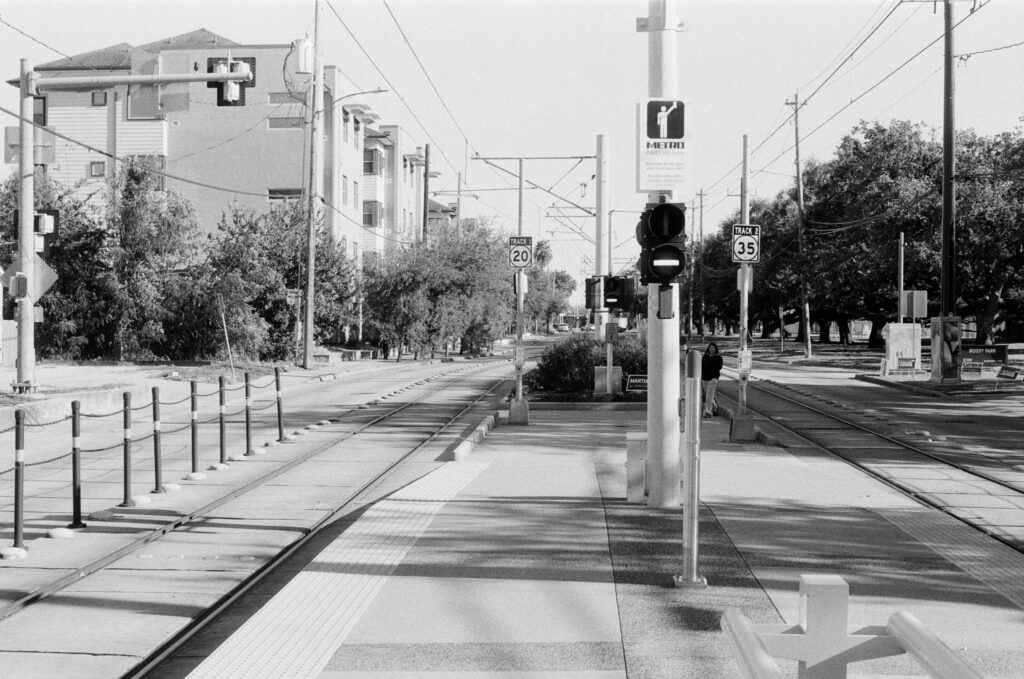
- An urban rail stop: a tram arrives, passengers boarding, city sign “Main at Texas” visible. Black-and-white grain heightens the hum of waiting, the tension of transit.
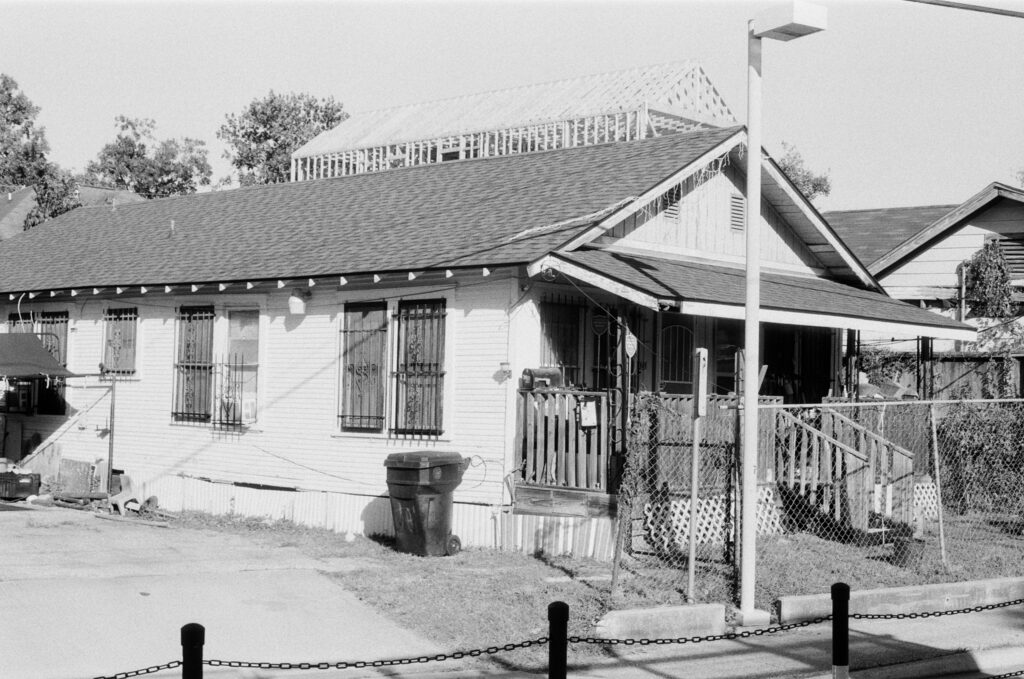
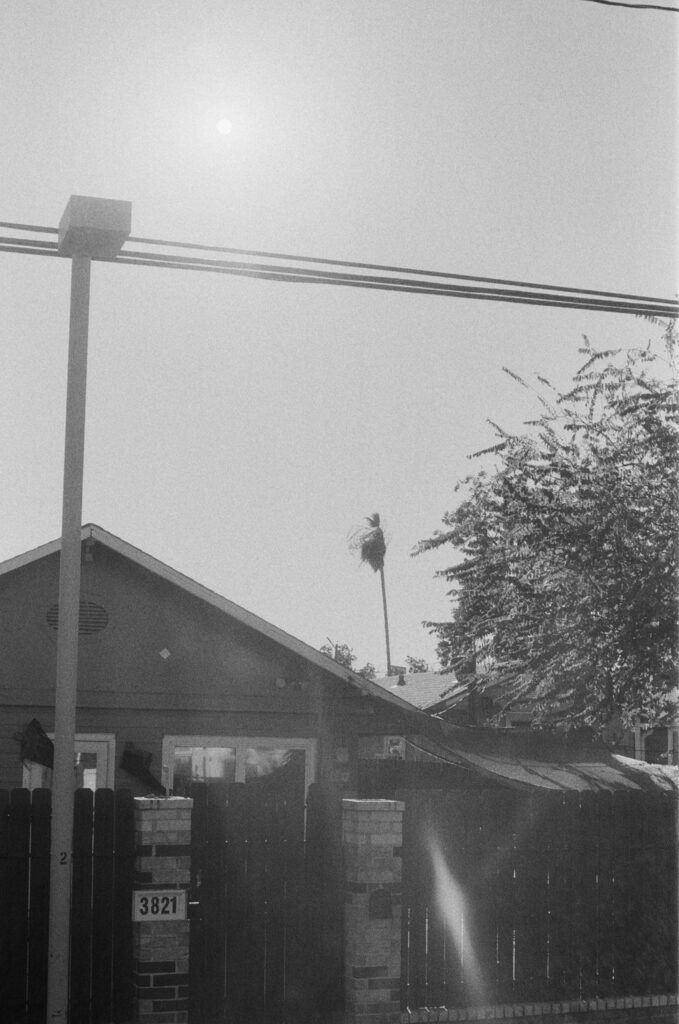
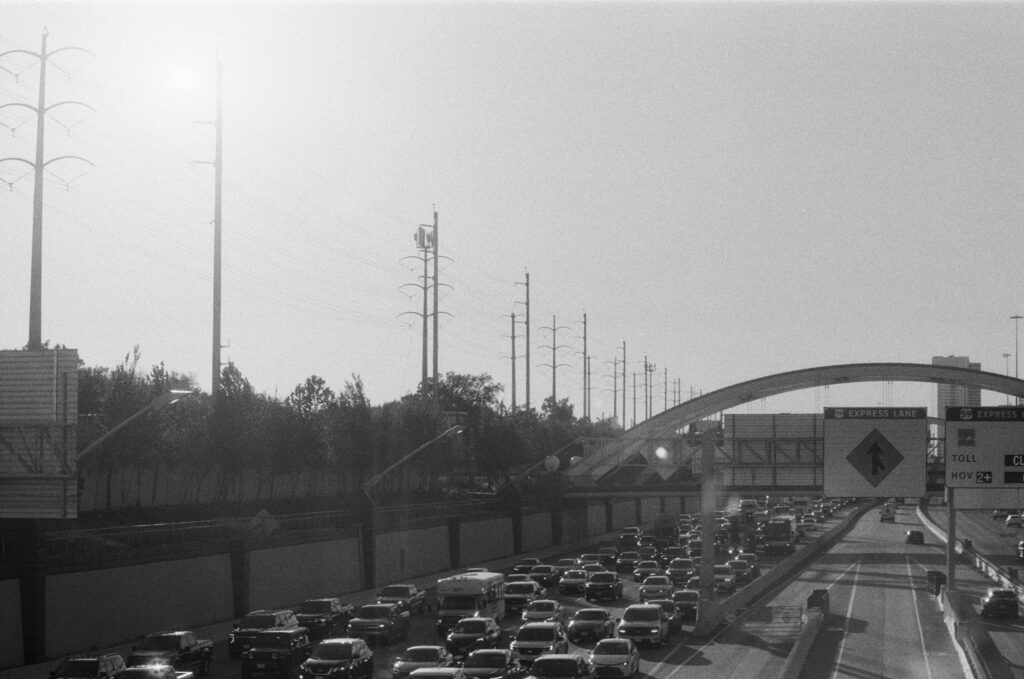
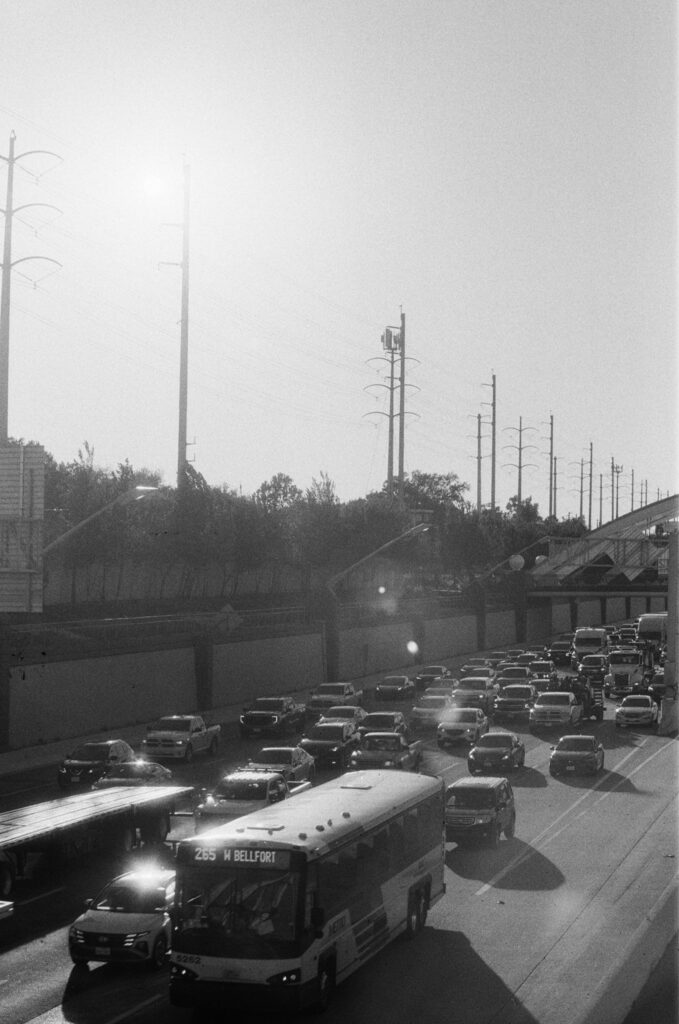
- A quiet residential sidestreet near downtown: the contrast between parked cars, chain-link fences, and the looming commercial towers hints at Houston’s sprawling, uneven growth.
Each photo holds a narrative: someone commuting, someone pausing, someone invisible yet connecting frames through place.
Houston: From Bayou Settlement to Metropolis
Founded in 1836, the city that would become Houston began at the confluence of Buffalo Bayou and White Oak Bayou. Two settlers, Augustus Chapman Allen and John Kirby Allen, laid out the townsite on land granted by the Republic of Texas.
In its early decades, Houston was gritty: marshy terrain, heat, yellow-fever outbreaks, violent encounters with the nearby Indigenous populations, and lawlessness of the frontier. Water transportation via the bayou and proximity to leagues of dense forest and swamp gave it rough character.
Then came the big pivot: the invention and proliferation of air-conditioning in the early-to-mid 20th century transformed Houston’s climate barrier into an asset. Suddenly the oppressive heat became manageable, the city grew rapidly, and the oil boom of the 1930s-70s anchored Houston as a global energy hub.
Post-war decades saw expansion outward in all directions—freeways, suburbs, industrial corridors—marking the city as sprawling, polycentric, and diverse. Downtown’s concrete and glass tell that growth story: the older low-rise facades of the 1920s–40s, the brutalist towers of the 1960s–80s, the shimmering new developments of the 21st century.
When you shoot in this downtown, you’re shooting a place where the past was rough and the present still pulses with energy.
Why This Matters
Street photography isn’t just about people walking past each other—it’s about place, history, systems of power and economy, and how light falls. In Houston’s downtown:
- The architecture reflects capital and change.
- The light shifts through tall buildings and wide boulevards.
- The human flow is diverse—executives, service workers, transit riders, tourists—all sharing pavement.
Capturing this on film with intent slows you down. You pick your frame. You listen. You wait. And then click. The resulting image has weight.
Technical & Editorial Notes for Your Workflow
- Film stock: FPP Eastman Double X (ISO ~250–400)
- Camera: Canon AE-1 Program; prime lens (50 mm f/1.8) recommended for street work.
- Settings: Consider shooting at ~1/250 s-1/500 s to freeze motion; use around f/5.6–f/8 for sharpness and depth.
- Composition: Look for layers — foreground human activity, mid-ground architecture, background sky/structure.
- Post-scan: Keep grain visible, avoid heavy correction; this stock thrives in contrast, not heavy smoothing.
- Metadata: Tag location (Houston, TX), film stock, camera, date, and any relevant street name or subject.
Final Thoughts
These frames are more than documentation—they are conversations with the street, the light, the city-scape and its people. Houston’s downtown may be evolving, sprawling, imperfect—but with film in hand you pause at the right moment and capture what matters.
The story isn’t just “this city”, it’s each person in this city. And each roll of film carries that truth.

Be the first to comment