


A Case Study in Word Games: How “Paid Protester” Claims Get Neutralized Without Being Answered

After attending the protest and observing the level of coordination, I sought documentation on funding and organization. What I found was not clarity, but carefully constructed ambiguity.
Google’s AI-generated response (which many now treat as an authority) insists that claims of paid protesters are a “misrepresentation of the facts.” But a closer read reveals something important: it never actually disproves the core concern. It simply reframes it.
Let’s break down how that works.
1. Redefining the Claim Instead of Addressing It
The response repeatedly states that there is “no evidence that individuals are paid to protest.” That sounds definitive—until you realize that isn’t what critics are actually alleging.
The concern is not that someone is handed cash at the curb for holding a sign.
The concern is that:
- Protest infrastructure is professionally organized
- Messaging is nationally standardized
- logistics, materials, transportation, promotion, and coordination are financially supported
- Participants are mobilized through organizations whose operating costs are funded by external donors
That is a materially different question—and one the AI response avoids entirely.
2. “Volunteer-Run” Does Not Mean “Unfunded.”
We’re told that Rise and Resist has “no full-time employees” and is “run by volunteers.” That statement is technically true—and also misleading.
Organizations can be volunteer-run and still funded.
They can operate without salaried staff and still receive fiscal sponsorship, grants, reimbursements, legal support, media amplification, and operational backing.
Fiscal sponsorship through organizations such as the A.J. Muste Memorial Institute isn’t neutral. It provides:
- tax-deductible donation pipelines
- administrative support
- legal and financial infrastructure
That doesn’t make an organization illegitimate—but it does mean the protest is not purely grassroots in the organic sense people are led to believe.
3. The Soros Question Is Narrowed Until It’s Meaningless
Notice how carefully the George Soros issue is handled.
The claim is framed as: “Soros does not pay individuals to protest.”
Again — that’s not the factual allegation.
What is documented is that:
- Soros-linked foundations fund networks of organizations
- Those organizations engage in mass mobilization campaigns
- PSL and similar groups have co-sponsored actions alongside organizations that receive such funding
The AI admits this—but then immediately dismisses its relevance.
That’s not debunking. That’s scope reduction.
4. “Membership-Funded” Is Not the Same as “Independent.”
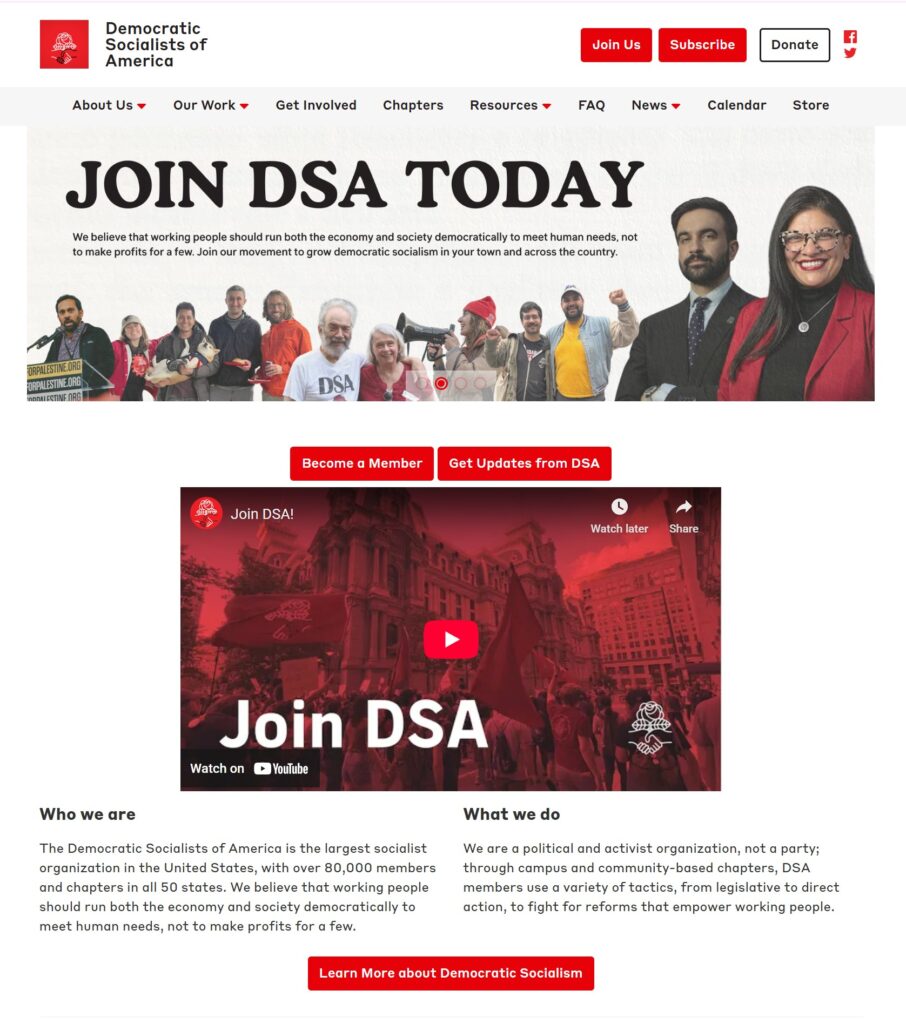
DSA is described as “membership-led” and funded by dues and small donations. That may be accurate—but it also avoids the question of organizational incentives.
When an organization:
- maintains chapters in dozens of cities
- deploys identical messaging nationwide
- mobilizes rapidly around breaking events
- funnels participants toward a single media outlet (LiberationNews.org)
…it begins to resemble a professional political operation, not a spontaneous civic response.
Grassroots movements are chaotic. This wasn’t.
5. The Escape Hatch: “Conspiracy Theory.”
Finally, the response labels concerns about paid protesters as “debunked conspiracy theories.”
This is the rhetorical kill switch.
Once a claim is categorized as a conspiracy, it no longer requires examination. Motives, funding structures, and coordination mechanisms—all disappear behind a semantic wall.
But journalism doesn’t work that way.
Raising questions about how movements are financed, organized, and incentivized is not paranoia. It’s standard practice. The fact that those questions elicit defensive language rather than transparent answers should raise eyebrows—not end the discussion.
Why This Matters
Whether or not a protester receives a paycheck is almost beside the point.
What matters is whether the movement being presented as “the will of the people” is:
- organically arising
- or strategically manufactured
When protests are coordinated through national organizations, supported by layered funding structures, and insulated from internal dissent, they cease functioning as grassroots feedback and instead operate as ideological delivery systems.
That doesn’t make the protesters evil. It makes the narrative incomplete.
And incomplete narratives are precisely what journalists are expected to challenge.

Be the first to comment