

When Activism Confuses Authority With Power
A Case Study From Houston PSL
Public protest movements often speak the language of rights, accountability, and liberation. Those principles only mean something if they’re applied consistently—especially when they’re inconvenient.
This piece documents a recent incident involving the Houston chapter of the Party for Socialism and Liberation (PSL), members of its volunteer medic team, and an independent photojournalist operating in a public space. This is not a personality dispute. It is a case study in how imagined authority replaces legal reality—and how movements react when that substitution is challenged.
Context: Why I Was There in the First Place
I didn’t seek out Houston PSL’s internal spaces. I was invited.
After photographing a public event, an event leader asked me to share the images. I was told to email them and was subsequently added to a Signal group. That group, for the record, was largely inactive—entry-level logistics chatter and the occasional post about “what to say to your MAGA parents over the holidays.” Hardly a command center.
I joined for one reason only: to share photos from public events I was already lawfully documenting.
That matters—because nothing that follows involves infiltration, deception, or misrepresentation. I was there openly, doing what I’ve done at dozens of protests without incident.
Public Space, Private Authority, and a Fundamental Misunderstanding
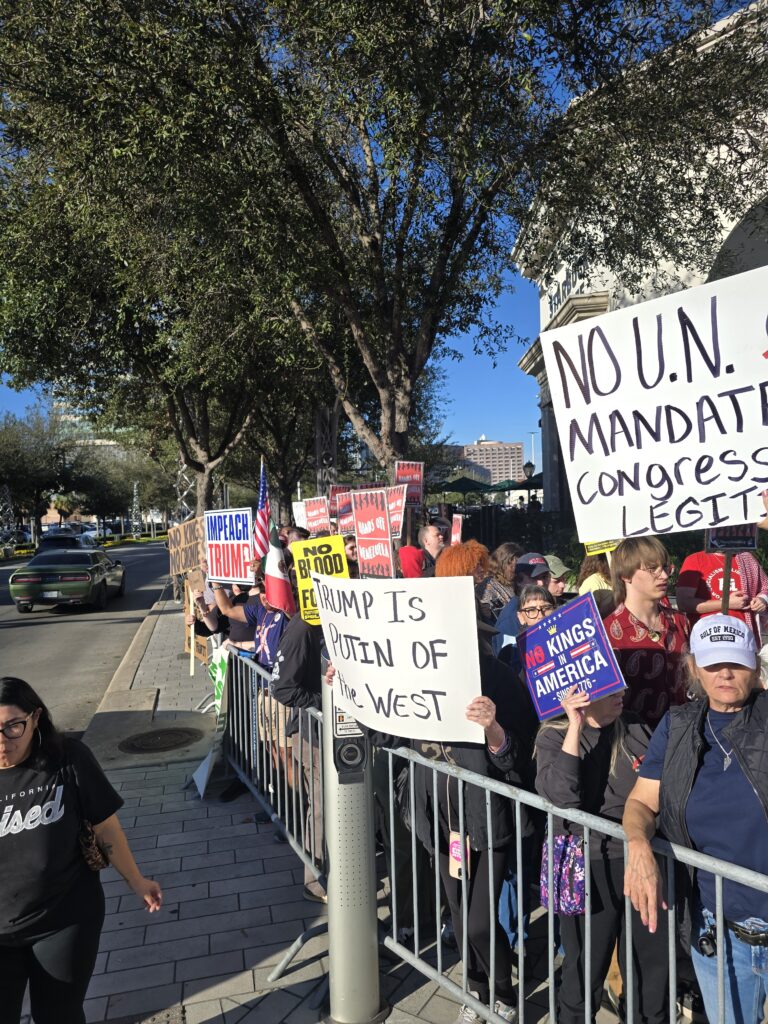
The incident in question occurred at a public demonstration in a fully public space. No private property. No restricted zone. No credential requirement.
That distinction is not semantic—it’s legal.
In public space, there is no expectation of privacy. A personal request not to be photographed—no matter how sincerely held—does not override the First Amendment. That is settled law, not opinion.
The conflict did not arise from the taking of photos.
It arose because a volunteer medic attempted to enforce a personal preference as if it were a binding authority.
What followed was escalation—not by documentation, but by confrontation.
What Actually Happened (Sequence Matters)
From my perspective—and corroborated by multiple witnesses—the sequence was simple:
- I photographed the event, including signs, people, and medics, as part of documenting the full scene
- A medic stepped aggressively into my physical space and ordered me not to photograph them
- I responded calmly but firmly: This is a public space, and I am exercising freedom of the press
- A second medic physically blocked my path as I attempted to move on
- I raised my arm to create distance and told them not to block or push me
That action was later described internally as “bodily shoving.”
It was not.
Creating space when someone blocks your movement is defensive boundary-setting, not aggression. Blocking someone’s path is not neutral behavior. It is an escalation.
“Zero Tolerance” — Applied Selectively
After the event, PSL leadership cited a “zero tolerance policy for putting hands on people.”
That policy was applied to me—but not to:
- stepping directly into someone’s path
- initiating physical proximity
- attempting to control movement in a public thoroughfare
The standard was enforced only in one direction.
This asymmetry matters. If “zero tolerance” applies selectively—only after escalation has already occurred—it is not a safety policy. It is a disciplinary tool used to protect hierarchy.
Fear Without a Threat
The justification given for restricting photography was “safety” and “protecting identity.”
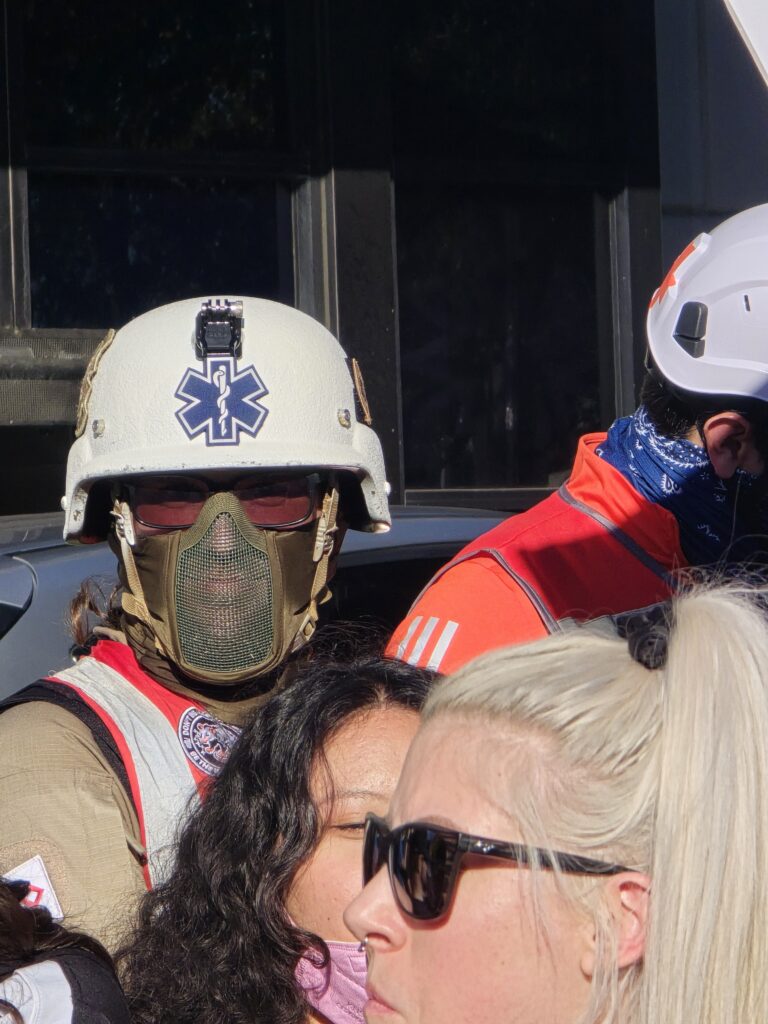
But the medic involved was already:
- wearing a face covering
- wearing eye protection
- operating in a crowd
- participating openly in a public action
There is no documented pattern of independent journalists targeting volunteer medics. No evidence of retaliation. No credible threat.
Fear alone does not create authority. And it does not justify confrontation, obstruction, or attempts to silence lawful observers.
The Illusion of Authority
What followed the incident reveals a deeper problem.
Rather than address the legal reality of public-space documentation, PSL leadership removed me from a Signal chat and framed that removal as “accountability.”
Let’s be precise:
- Removing someone from a private chat does not establish jurisdiction over public space
- It does not retroactively legitimize an unlawful demand
- It does not convert volunteer status into authority
Volunteer organizations—no matter how committed—do not grant themselves power over constitutional rights by consensus vote.
That isn’t how rights work.
When Facts Entered the Room, the Conversation Ended
After laying out a detailed, fact-based response—addressing the accusations point by point, citing public space law, and explaining the sequence of events—the reply from PSL leadership was not a rebuttal.
It was this:
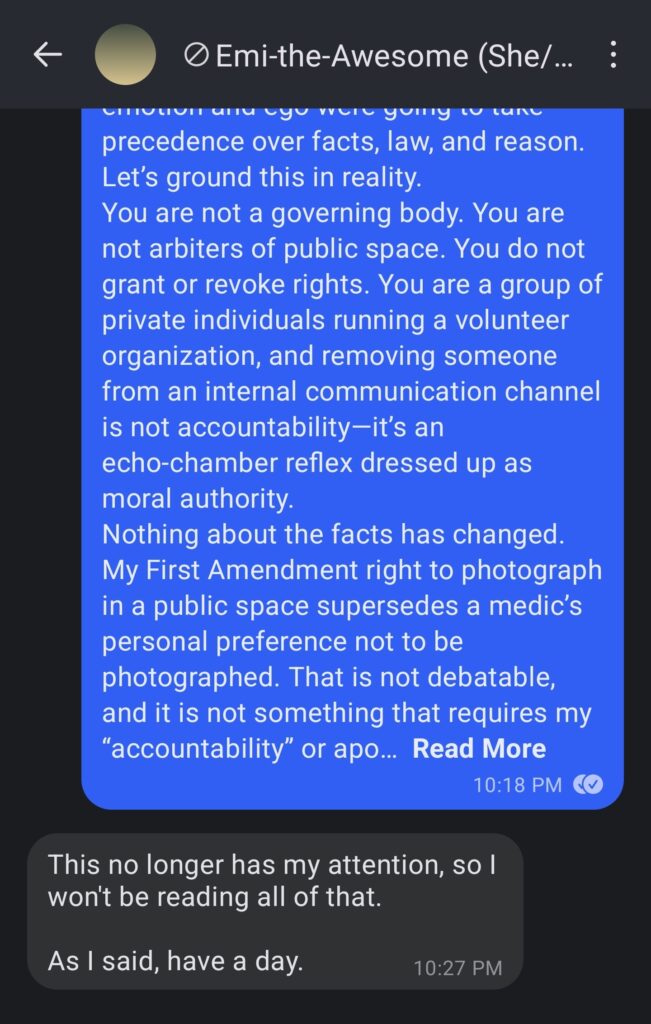
“This no longer has my attention, so I won’t be reading all of that.”
That line matters more than any other in this exchange.
Because it marks the moment when engagement ended precisely as facts entered the discussion.
This wasn’t de-escalation. It was a refusal.
Manufactured Power in a Low-Friction Environment
Houston is not New York.
Protests here are smaller, calmer, and far less confrontational. That context matters. In environments where little actually happens, some participants appear hungry for a moment to assert authority.
Once I saw two medics pairing up and conferring while pointing me out, the trajectory was obvious. This wasn’t about safety. It was about validation—about creating an incident where none naturally existed.
When that incident collapsed under scrutiny, disengagement replaced dialogue.
Numbers Matter: Representation vs. Reality
Houston’s metropolitan population exceeds 7 million.
Based on visible attendance:
- ~600 people attend most PSL street actions
- ~25–30 regularly speak at the city council
- ~1,500 attended the largest “No Kings” rally
Even the largest turnout represents well under 0.03% of the metro population.
This doesn’t invalidate protest—but it matters when organizations present themselves as the voice of the people while enforcing internal conformity and silencing lawful dissent.
Grassroots movements are messy. They tolerate friction. They survive scrutiny.
When a group becomes rigid, defensive, and hostile toward observation, it ceases to behave like a movement and begins to behave like a club protecting its hierarchy.
The Core Contradiction
PSL messaging routinely condemns:
- silencing
- authoritarian behavior
- control of public expression
Yet in practice, the response to lawful documentation was:
- command
- confrontation
- exclusion
- disengagement once challenged
That contradiction isn’t theoretical. It played out in real time.
Final Thought
This was never about access to internal spaces. It was about boundaries—legal ones.
Public demonstrations invite public witnessing.
Public space belongs to everyone.
And no amount of moral certainty substitutes for law.
Independent documentation isn’t the enemy of activism.
It’s one of the few things that keep it honest.
Primary Source Appendix: Full Communication Record
To avoid accusations of selective quoting or misrepresentation, the complete text exchange below is presented verbatim, with speakers clearly labeled. Readers are encouraged to review the language, tone, and progression for themselves.
This is the full record of the communication referenced above.
Emi-the-Awesome (PSL Organizer)
Hello! I understand you were wondering why your access was removed from some spaces? I am here to answer questions you may have.
I am also about to step away from my phone so will respond around 7:30 at the earliest
Jay Rod (Independent Photojournalist)
Yes, did i do something wrong? Last thing I posted was a dsa event to spread the word
Emi-the-Awesome
After a recent event, during our retrospective, the medic team reported an incident, and with some digging, we determined that you were the individual that the incident occurred with.
the incident in question was that the medics team asked the individual to please not photograph the medic team and the injured person they were treating. That individual got hostile, told them they (the medics) ‘couldn’t tell them what to fucking do’, and bodily shoved one of our medic team members.
We do not tolerate this behavior, and presumed that such an incident was either something that would be understood as an unreasonable and unsafe way to behave in community, especially in regards to a request from someone who was trying to protect the identity and medical safety of a community member, or, that this behavior is so common from this individual that our private conversation spaces would be safer with their absence.
Jay Rod
Witnesses to the event verified your account details and you from photos.
Ahhhh yes I will respond with from my point of view there are always two sides to a story. I have been to many events never having issue but there is always going to be one bad apple. I was there tonight and had zero issue. I will text more later and you can forward my message to whatever forum this took place
Emi-the-Awesome
We have a zero tolerance policy on putting hands on people.
Jay Rod
I’m aware this probably won’t land well for everyone. Most people struggle with being wrong, and the ego often gets in the way. Still, I’ll give the benefit of the doubt that logic and reason matter here—especially when this involves people who consider each other comrades, friends, or allies.
I’ve attended a lot of rallies and protests. I take my independent photojournalism seriously, but I also genuinely enjoy it. I shoot film because it forces intention. It slows things down. It captures emotion in a way spray-and-pray digital never will. I’m there to document—not to posture, not to provoke, not to play activist cosplay.
Until this incident, I’ve never had a single issue at any event.
Here’s what happened, from my perspective.
I arrived and began photographing from outside the gated area, then decided to move into the crowd for closer shots. My goal is always the same: tell the whole story. That means signs, faces, chants, drummers, medics—everything that makes the moment what it is. I photographed a group of medics in a public setting, then lowered my camera and took a shot of a medic bag as I passed.
At that point, one medic stepped directly into my space and told me, aggressively, not to photograph them. Getting in someone’s face is escalation, whether people want to admit it or not. I respond to the energy I’m given. I’m generally polite to a fault—but if someone comes in hot, I won’t pretend otherwise.
I told him plainly: that’s not how this works. This is a public space, and I’m exercising freedom of the press. He repeated the demand. I repeated that he doesn’t have the authority to silence or command me.
Yes, voices were raised—but it was a rally. Everyone was already loud. Matching the ambient volume of the crowd isn’t “yelling”; it’s basic communication. His tone matched mine exactly.
As I tried to move on, a second medic stepped into my path. That crossed a line. I raised my arm to create distance and told him not to push or block me. That wasn’t aggression—it was self-protection. Blocking someone’s movement is not neutral behavior.
I continued photographing elsewhere, then turned back to exit the same way I came. I told them clearly: I’m walking through, I don’t want issues, just stay clear. No problems. I assumed that was the end of it.
It wasn’t.
Later, while shooting again, I noticed the first medic speaking to a PSL member in a red shirt. They were just a few feet away. The medic looked at me, then the PSL member did. It was obvious what was happening.
Sure enough, the PSL member approached me and told me I needed to “respect the medic’s request” not to be photographed. I explained—again—that personal discomfort does not override a constitutional right. That’s when the familiar tactic came out: “Your energy is too loud.”
It’s a neat rhetorical trick. Whoever says it first gets to frame the other person as unreasonable. In reality, we were speaking at the same volume, in the same loud environment. I raised my voice only at the very end, as he walked away, to say: isn’t silencing people literally what you claim to be fighting against?
Then I left.
Here’s the bigger issue.
These events happen in public spaces. In public spaces, the press—independent or otherwise—has the right to photograph and document what occurs. That’s not opinion. That’s the First Amendment. Personal preferences do not override federal law.
There are two competing requests here:
• A constitutional right.
• A personal desire not to be photographed.Only one of those carries legal weight.
What should have happened is simple: organizers should have made it clear internally that press coverage is part of public demonstrations. If someone is uncomfortable being photographed, they need to understand that attending public protests comes with that reality.
What shouldn’t happen is volunteers mistaking proximity to an organization for authority. No one here has the power to issue commands to other citizens. Removing someone from a group chat doesn’t create legitimacy—it just creates the illusion of control.
I’ll continue documenting events as I always have. I stay out of the way. I don’t interfere. I respect the space. I take pride in telling the whole story, and medics—whether they like it or not—are part of that story.
At the most recent event, I had zero issues. Yet I still watched someone spot me, run to the same medic, and point me out like I was some cartoon villain. That kind of behavior isn’t activism—it’s drama.
I don’t show up looking for conflict. I don’t harass people. I don’t block walkways. I don’t escalate situations. Anyone who’s actually observed me working knows that.
In closing, if someone chooses to attend public events, they need to accept that they may be photographed. There’s no secret police coming for volunteer medics handing out water. Masks and glasses already provide anonymity. A personal request does not nullify a constitutional right.
That’s not hostility. That’s reality.
Emi-the-Awesome
Your message was received, and the community and auxiliary are unswayed.
We, of course, can no more deny you attendance to the public square than we could or would do so to any other.
We stand by the choice to remove your access to our own community spaces, due to your behavior, and now also, due to your lack of accountability for your poor behavior and a clear inability at this time to repair the damage done to the community fabric.
Please know that this decision may only be revisited if there is such a time as you are able to approach the community and the individuals you created conflict with in genuine apology and said accountability.
Have a day.
Jay Rod
Your response confirms exactly what I expected.
To be clear: my message was never about regaining access to a Signal thread or being “welcomed back” into what is, at the end of the day, a volunteer-run chat space with no authority beyond what you imagine for yourselves. I already understood—based on your actions at the event—that emotion and ego were going to take precedence over facts, law, and reason.
Let’s ground this in reality.
You are not a governing body. You are not arbiters of public space. You do not grant or revoke rights. You are a group of private individuals running a volunteer organization, and removing someone from an internal communication channel is not accountability—it’s an echo-chamber reflex dressed up as moral authority.
Nothing about the facts has changed.
My First Amendment right to photograph in a public space supersedes a medic’s personal preference not to be photographed. That is not debatable, and it is not something that requires my “accountability” or apology. Had your group properly educated its volunteers on this basic reality, this situation would not have occurred in the first place.
Instead, one of your medics chose to escalate: getting in my face, issuing commands they had no authority to give, and physically placing themselves in my path. That behavior is not de-escalation. It is provocation. Yet somehow, that conduct required no reflection, no accountability, and no repair—only my refusal to submit to it did.
That contradiction speaks for itself.
You are free to curate your internal spaces however you wish. Losing access to a chat thread I already described as “meh” changes nothing about my work, my presence, or my rights. I asked for clarity on why I was removed and stated my position plainly. That objective has been met.
What will continue is this: I will attend public events. I will document them fully. I will photograph signs, crowds, organizers, drummers, medics—anyone participating in public action in public space. That has always been the case, and it will remain so.
If left alone, I leave people alone. That’s how every event I’ve covered—except this one—has gone. But if anyone blocks my path, gets in my face, or attempts to silence lawful documentation, I will stand my ground.
The solution here is simple and entirely within your control: hold your volunteers accountable, educate them on public-space realities, and instruct them not to confront or obstruct photographers. Do that, and this issue disappears permanently.
See y’all around.
Emi-the-Awesome
This no longer has my attention, so I won’t be reading all of that.
As I said, have a day.

Be the first to comment