

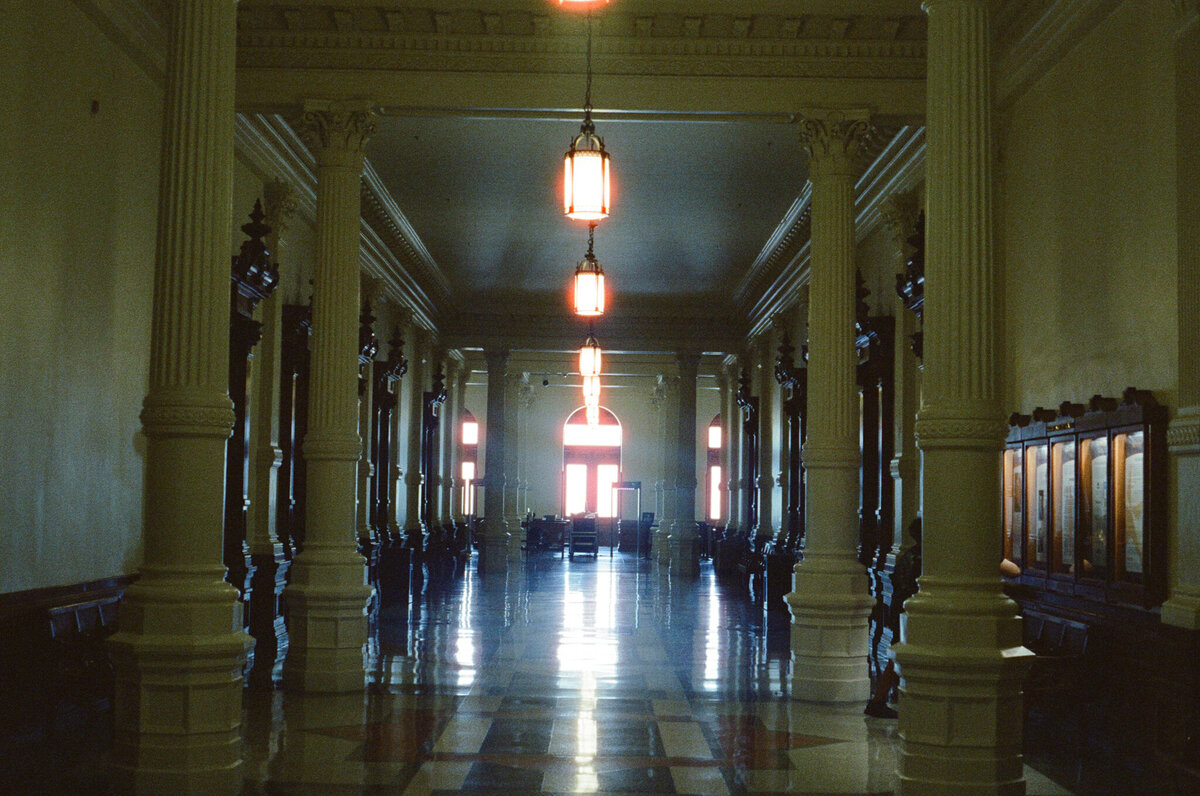
Infrared as a Discipline — Working with Film Photography Project (FPP) Infrared Film
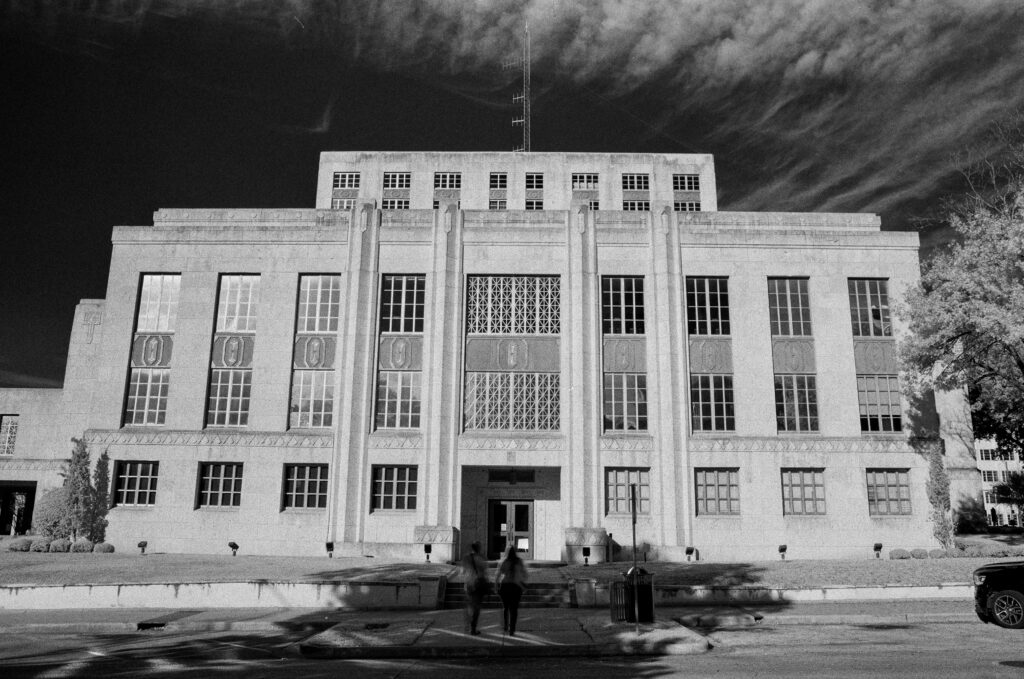
Infrared photography doesn’t reward confidence.
It rewards patience.
It doesn’t care how many rolls you’ve shot or how comfortable you feel behind a camera. Infrared photography reduces it to physics—wavelength, reflectivity, exposure, and time. You either respect it or you fight it. And if you fight it, you lose.
This series was shot on Film Photography Project (FPP) Infrared Black & White 35mm film and represents a deliberate step beyond near-infrared experiments into something more demanding.
After working with Ilford SFX 200, which sits comfortably at the edge of the infrared spectrum, I wanted to push further — past safety nets, past forgiving latitude, into a film stock that forces every decision to matter.
That’s where FPP Infrared lives.
⚙️ Gear & Settings Sidebar
Camera
Canon T90
Chosen for its reliable metering (without the filter), excellent ergonomics, and confidence-inspiring weight when shooting slow, handheld frames. All exposures were metered without the filter, then manually compensated.
Lenses
Manual-focus FD lenses
Mid-range focal lengths were favored for architectural compression and controlled perspective. No autofocus, no shortcuts. Focus was always set before mounting the infrared filter.
Film
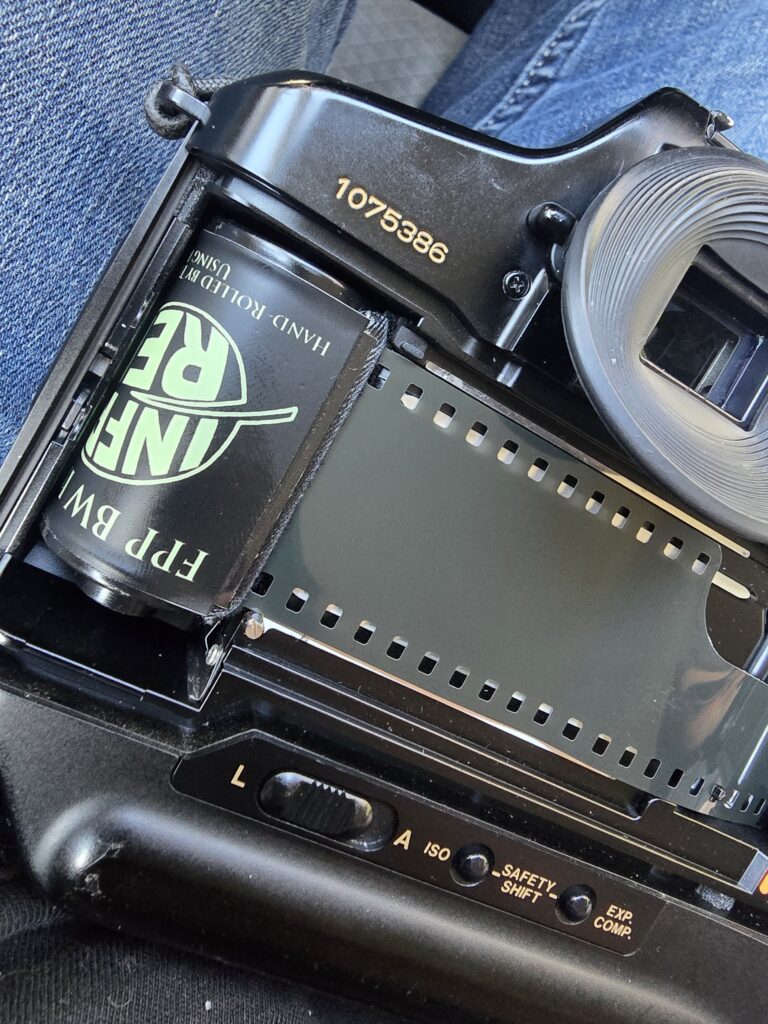
Film Photography Project (FPP) Infrared Black & White 35mm
Nominal ISO 200 rating, but box speed is largely irrelevant once filtered. Thin base stock — load and unload in dim light to avoid light piping.
Filter
Deep Red / Infrared Filter (R72-equivalent)
Blocks most visible light and allows infrared wavelengths (~700–850nm) to reach the film. This filter defines the entire workflow and introduces a significant exposure penalty.
ISO Assumptions
Effective ISO: ~6–12
• Bright, direct Texas sun → closer to ISO 12
• Thin cloud cover or mixed reflectivity → closer to ISO 6
All metering was done without the filter, then compensated manually.
Focus Method
• Compose
• Focus
• Mount filter
Infrared light focuses differently than visible light. Where available, IR focus marks were respected. Otherwise, stopping down was used as insurance.
Shooting Method
All frames shot handheld
No tripod. No bracing against walls. Controlled stance, breath timing, and acceptance of motion blur and ghosting where it naturally occurred.
Development & Scanning
• Standard black & white chemistry
• No special development tricks
• Scanned conservatively to protect highlights
Contrast was respected, not “corrected.” The goal was to let the film behave like itself.
What FPP Infrared Actually Is
FPP Infrared is a black & white infrared-sensitive film produced and distributed by the Film Photography Project, a community and supplier dedicated to keeping alternative and experimental film stocks alive.
Unlike SFX, which responds to infrared, FPP Infrared reaches much deeper into the IR spectrum, roughly 0–850nm, when used with an appropriate filter.
This is not a novelty film.
It’s not designed to be “easy.”
The film is nominally rated at ISO 200, but that number is academic, mainly once you introduce an infrared filter. Once filtered, visible light is heavily suppressed, and you’re working almost entirely with reflected infrared radiation — which means effective ISO drops dramatically.
You don’t shoot this film at box speed.
You interpret it.
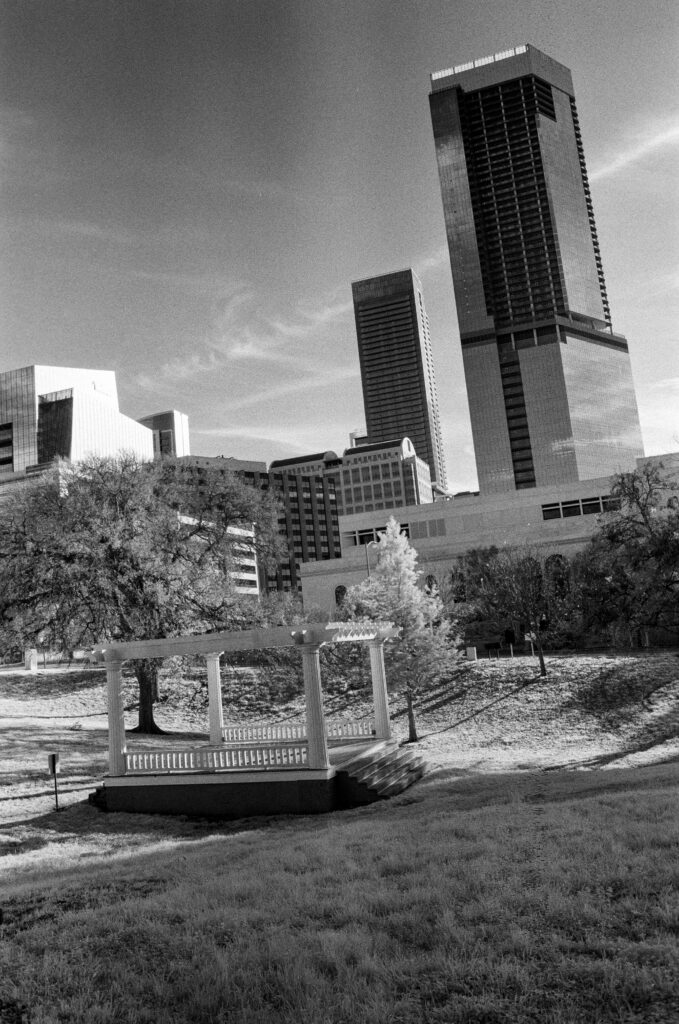
Filters Are the System
Infrared photography lives and dies by filtration.
For this roll, I used a deep red infrared filter (R72-equivalent). This filter blocks most visible light and allows infrared wavelengths to reach the film. Without it, FPP Infrared behaves more like a conventional panchromatic black-and-white stock. With it, the world transforms.
The filter is not an accessory.
It is the workflow.
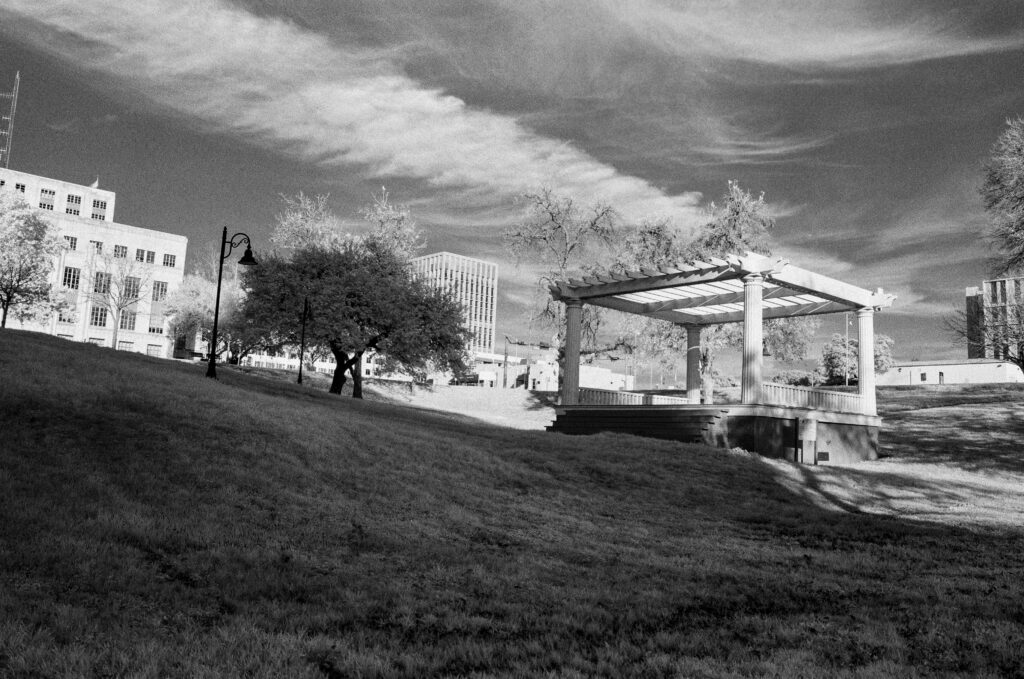
Once the filter is applied, you immediately incur an exposure penalty—typically 4 to 7 stops, depending on sun strength, subject reflectivity, and atmospheric conditions. Metering through the filter is unreliable, especially on older film bodies.
Every exposure here was metered without the filter, then manually compensated.
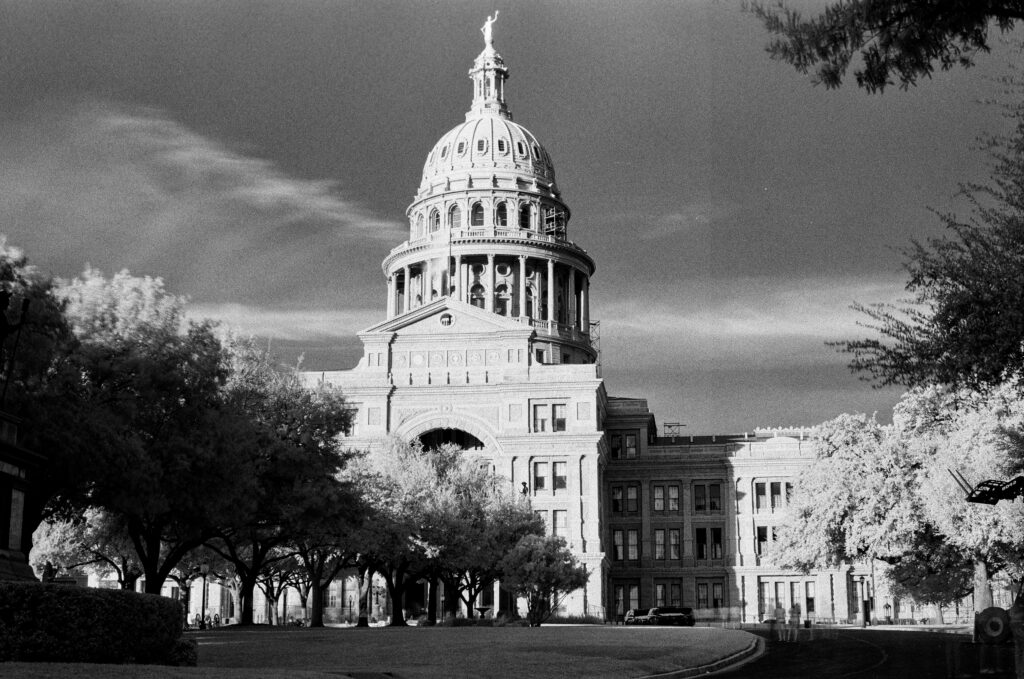
ISO Is a Decision, Not a Number
For this series, I treated FPP Infrared as roughly ISO 6–12.
Bright Texas sun? Lean closer to 12.
Thin clouds, mixed light, or reflective stone? Drop lower.
This wasn’t guesswork — it was observation, bracketing mentally, and accepting that infrared doesn’t behave like visible light.
Infrared exposure is less about correctness and more about intentional bias.
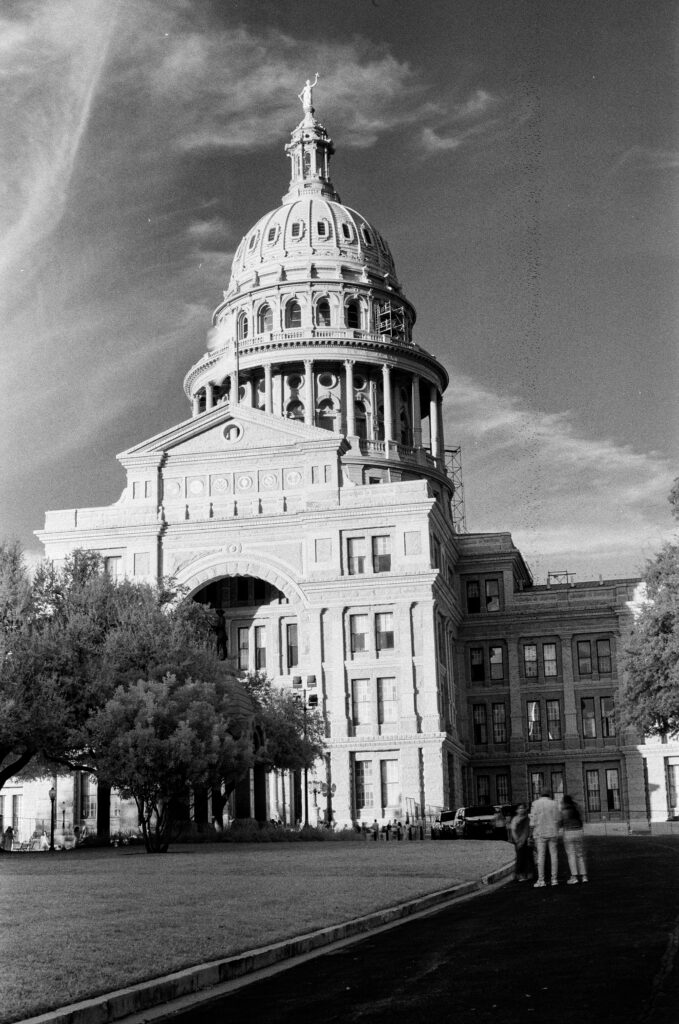
Focus Happens Before the Filter
Infrared light focuses at a different plane than visible light. That’s not folklore — it’s physics.
Every shot in this set followed the same discipline:
- Compose
- Focus
- Then mount the filter
If your lens has an infrared focus mark, use it. If it doesn’t, stopping down becomes your safety margin. Wide apertures introduce risk. Sharpness has to be earned.
Infrared punishes shortcuts.
Handheld, But Not Casual
Every photograph here was shot handheld.
That doesn’t mean careless.
Handheld infrared demands intention — stance, breath control, and anticipation of motion blur. Shutter speeds are slower than you’d like, especially when using filters. People move. Leaves shimmer. Time leaks into the frame.
The ghosting you see isn’t an error.
It’s the infrared revealing duration.
Why Architecture Thrives in Infrared
FPP Infrared loves architecture.
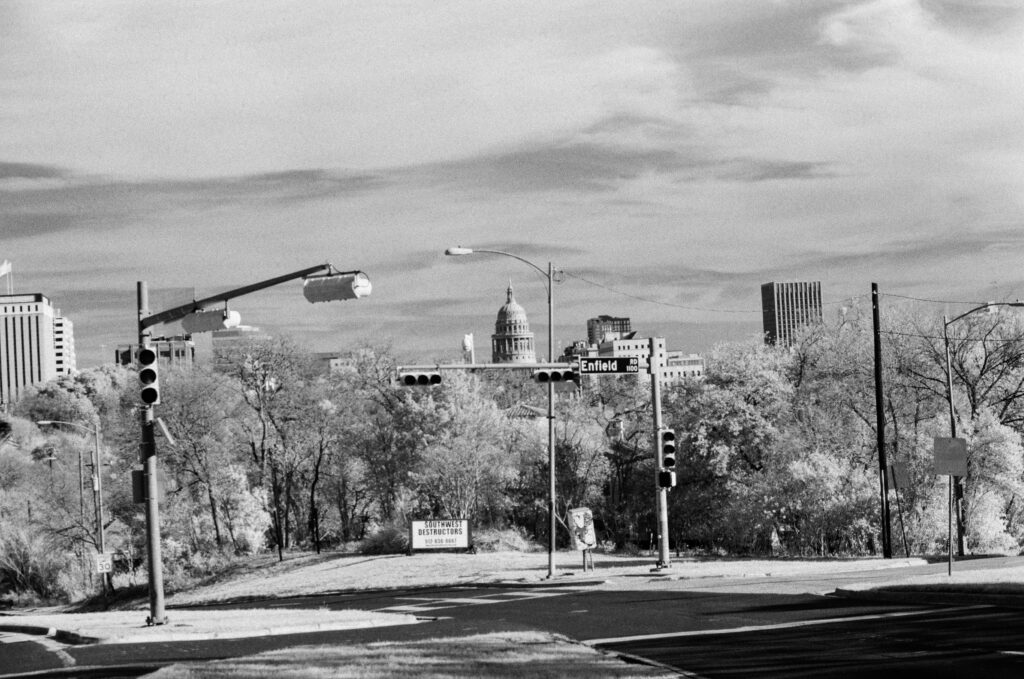
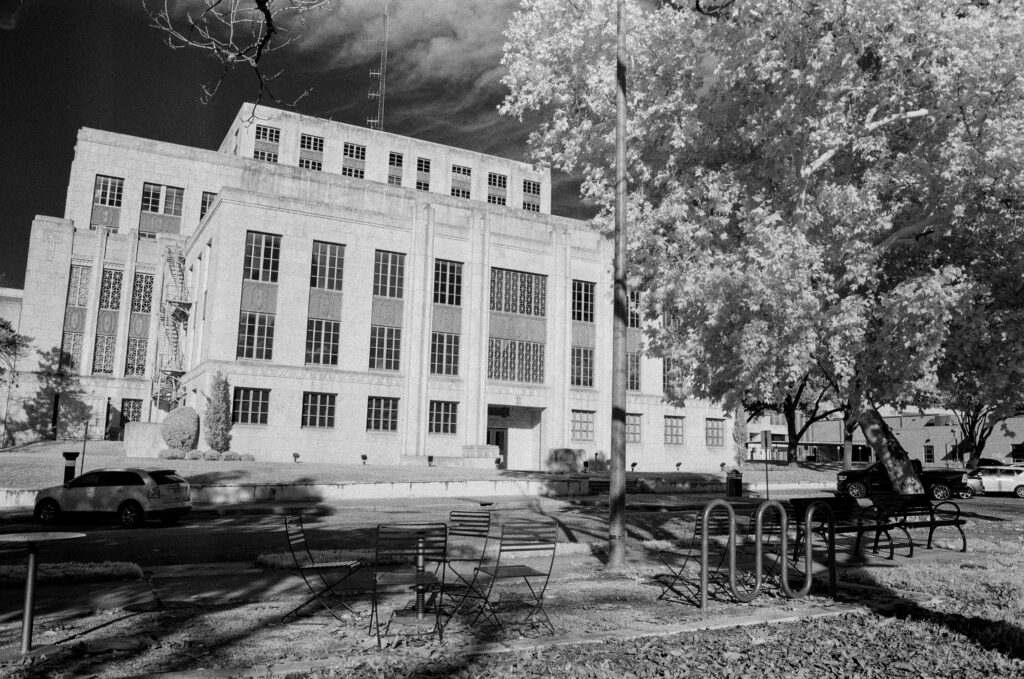
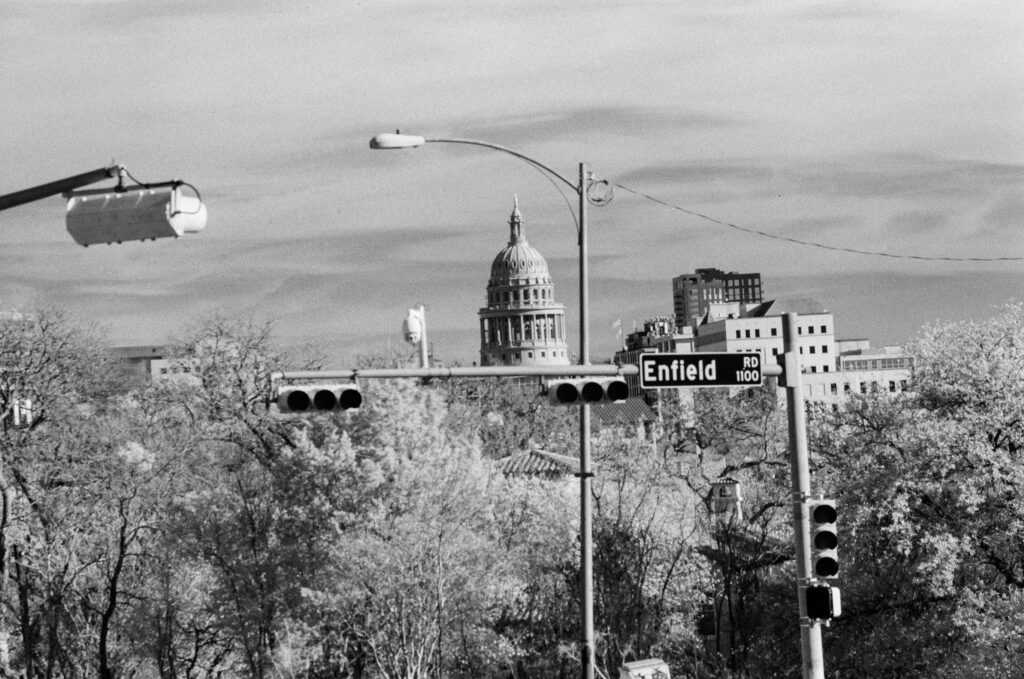
Stone, concrete, and civic buildings reflect infrared in a way that feels sculptural. Decorative details flatten. Windows turn into voids. Skies deepen, and clouds carve themselves into layers that weren’t visible moments earlier.
That’s why places like capitols, courthouses, and mid-century public buildings become ideal infrared subjects.
Infrared removes surface noise and leaves the structure.
FPP Infrared vs Ilford SFX 200
If Ilford SFX 200 is infrared as a lesson, FPP Infrared is infrared as an exam.
SFX offers flexibility. It forgives minor exposure errors. It introduces infrared gently.
FPP Infrared does none of that.
Highlights clip faster. Shadows collapse sooner. Latitude narrows. The margin for error shrinks — but when it works, the results feel heavier, stranger, and more intentional.
SFX teaches you how to see.
FPP tests whether you were paying attention.
Handling and Development Realities
FPP Infrared is built on a thin base, which means it’s susceptible to light piping. Loading and unloading should always be done in dim light. Bright sun and casual handling will show up on your negatives.
Development is straightforward—standard black-and-white chemistry works fine—but scanning requires care. Highlights can clip easily, and contrast must be respected rather than “fixed.”
This film wants to look like itself.
What Didn’t Work (And Why That Matters)
Not every frame on this roll worked.
Some skies flattened. Some highlights pushed too far. A few frames dipped into underexposure. That’s part of the process — and part of why this film matters.
Infrared isn’t about perfection.
It’s about understanding why a frame failed and carrying that knowledge forward.
Failure is feedback.
FPP Infrared isn’t a casual choice.
It’s not a film you load because you want something “cool.” It’s a film you load when you’re ready to slow down, commit to a workflow, and accept that the film might win sometimes.
This roll reinforced something essential for me to: infrared photography isn’t about spectacle — it’s about discipline.
This is infrared without training wheels.

Be the first to comment