
Why the “Kidnapping” Narrative Falls Apart
Notes From the Street on Venezuela, Protest Politics, and the Cost of Ignoring Reality
I don’t attend protests to confirm my beliefs. I attend them to test them.
That means listening closely, watching carefully, and then comparing what’s being said in the street with what’s verifiably happening in the world beyond the megaphones. That discipline matters most when emotions run high—because outrage, when left unchecked, has a way of replacing facts with slogans.
The recent protests opposing U.S. actions involving Venezuela—and specifically the rhetoric pushed by the Party for Socialism and Liberation (PSL)—offered a clear example of how narrative framing can drift far from reality.
What follows isn’t a defense of any politician. It’s a response to a storyline that collapses under even modest scrutiny.
The Setup: Conclusions Disguised as Headlines
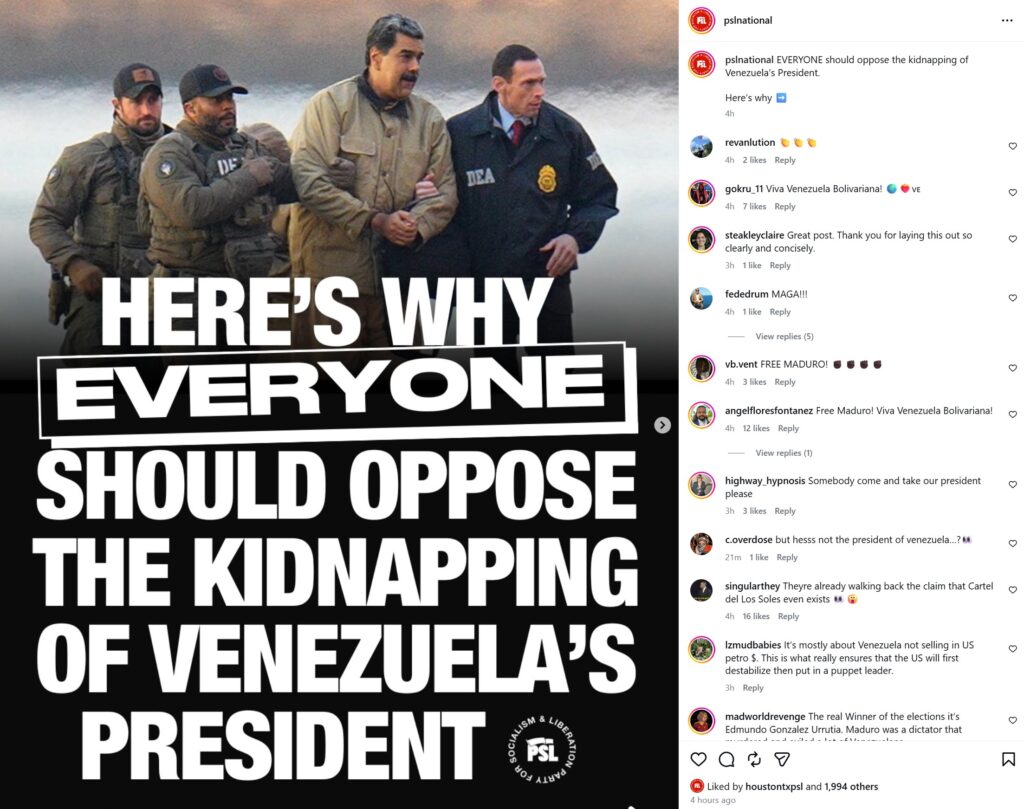
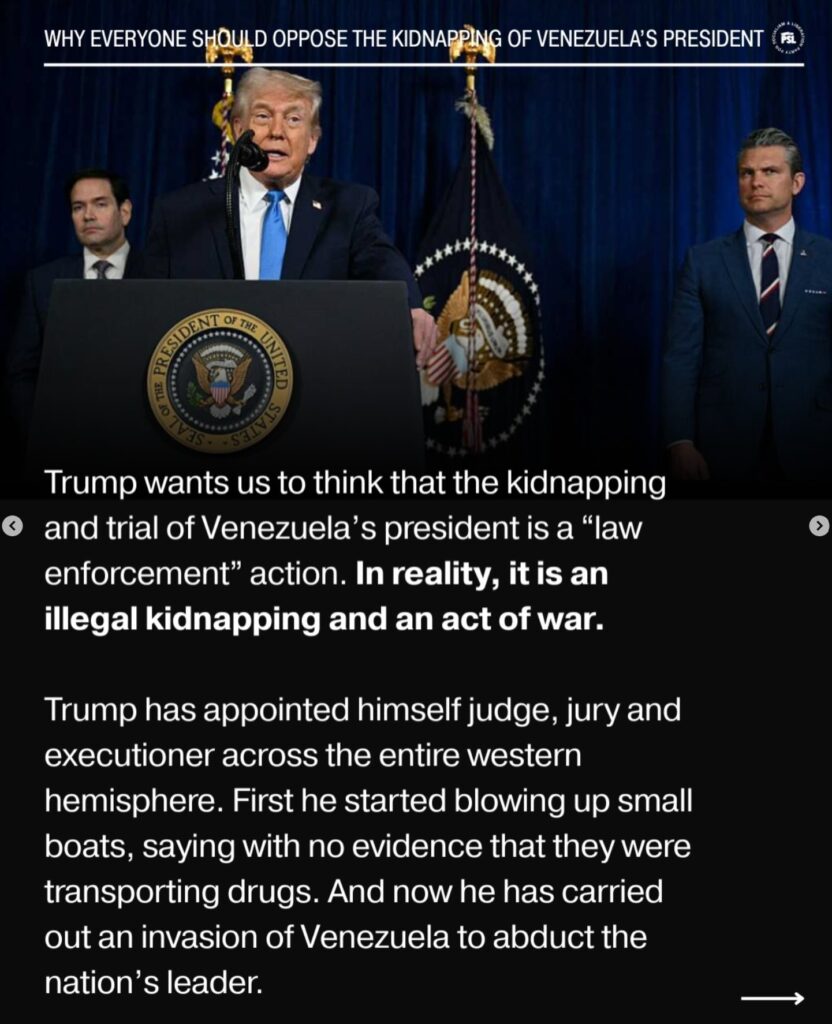
The first thing PSL does is front-load the conclusion.
Words like “kidnapping,” “illegal,” “act of war,” and “invasion” appear before the reader is given any factual framework. This is not accidental. It’s rhetorical compression — language doing the heavy lifting so evidence doesn’t have to.
Once those words are accepted, everything that follows becomes emotionally inevitable. But language is not proof, and repetition is not validation.
What’s notably absent from this framing is scale, scope, and outcome. There is no sustained U.S. military presence in Venezuela. No occupation. No rolling air campaign. No cities leveled—no escalation spiral.
According to all credible reports, this was a brief, targeted operation followed by a withdrawal.
Calling that a war isn’t analysis — it’s narrative inflation.
The False Analogy That Fuels the Outrage
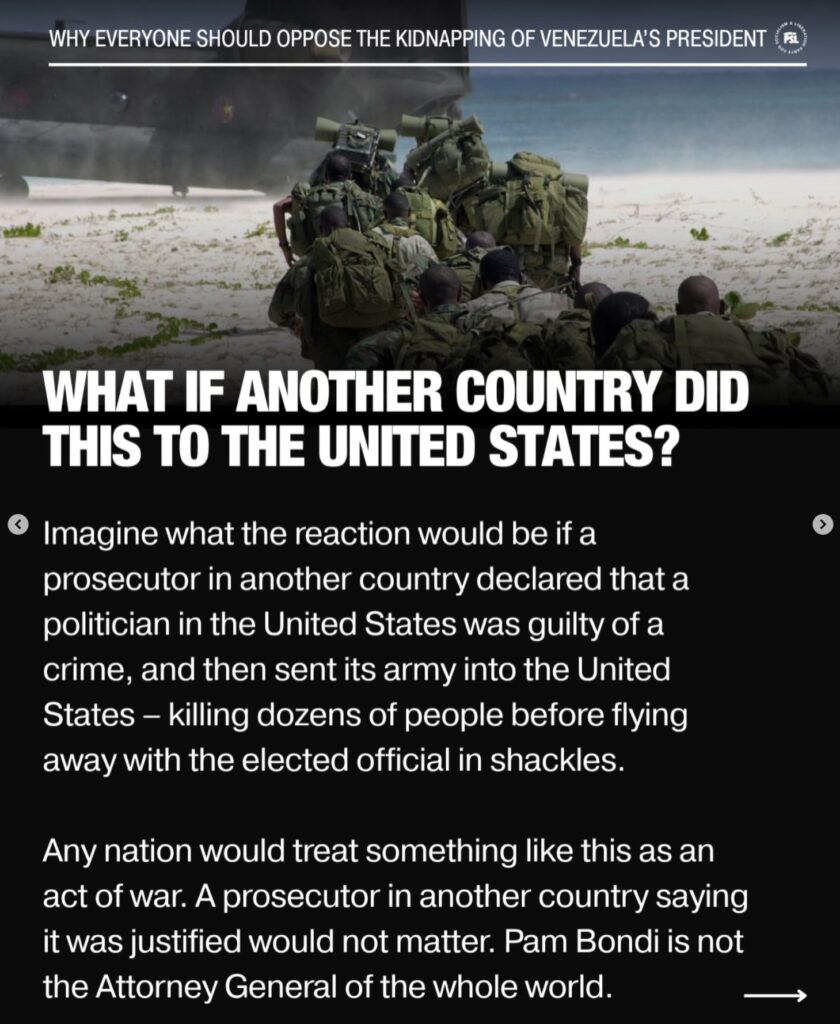
PSL leans heavily on a hypothetical: “What if another country did this to the United States?”
It’s emotionally compelling — and intellectually flawed.
The analogy assumes symmetry where none exists. Venezuela is not a constitutional democracy with independent courts, a free press, or internationally recognized elections. Nicolás Maduro is not simply a foreign leader with policy disagreements — he is a figure long accused of election manipulation, suppression of dissent, and entanglement with criminal networks.
Analogies that erase those distinctions don’t clarify reality. They sanitize it.
This isn’t how serious geopolitical analysis works. It’s how outrage is manufactured.
The DEA Argument That Doesn’t Say What They Claim
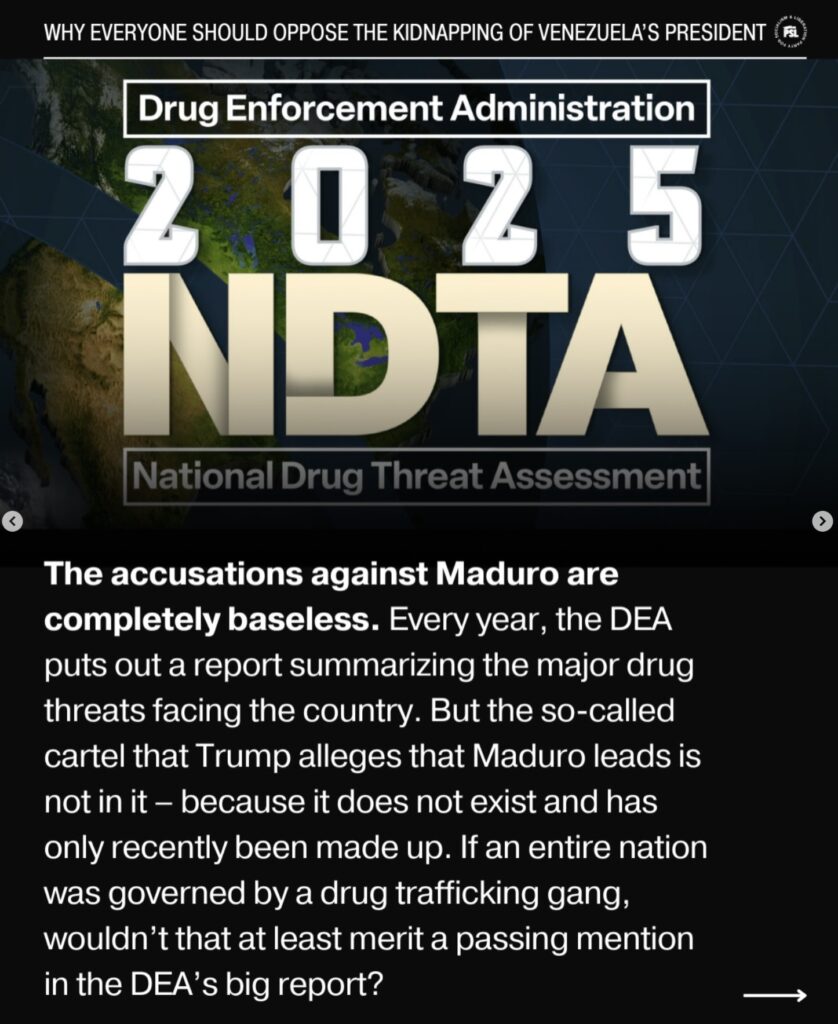
One of the more technical slides leans on the DEA’s National Drug Threat Assessment, arguing that because a specific cartel label isn’t emphasized, the accusations against Maduro must be “completely baseless.”
This is a misreading — and a convenient one.
NDTA reports are designed to prioritize domestic threat impact, not to serve as comprehensive verdicts on foreign state corruption. Absence from a summary document is not exoneration. Intelligence assessments are not court rulings, and they are certainly not exhaustive catalogs of international criminality.
Using one report to erase years of indictments, sanctions, and multinational allegations isn’t skepticism. It’s selective reading.
Oil, Power, and the Simplest Story That Avoids Accountability
The claim that “this is really all about oil” is familiar, catchy — and deeply lazy.
Venezuela indeed sits atop some of the largest proven oil reserves in the world, making its petroleum industry globally significant. That fact inevitably draws attention from major powers, investors, and analysts alike. But reducing the entire situation to oil theft collapses far more than it explains.
First, listen to how the U.S. government itself has framed its actions. In public remarks following the operation that captured Nicolás Maduro, President Trump said the United States would “run the country until we can do a safe, proper, and judicious transition,” suggesting a temporary administrative role for the sake of stability and rebuilding. This was later clarified by Secretary of State Marco Rubio, who emphasized that the goal was not indefinite control, but to influence Venezuela’s policy direction and prevent hostile actors from dominating the country’s oil industry — because, in his words, the U.S. doesn’t need Venezuelan oil, but won’t allow it to be controlled by adversaries. Argus Media+1
Trump’s comments are controversial, yes — but they show the logic isn’t simply “get the oil and leave.” Instead, the message is rebuild the industry under a new framework and limit hostile control over it.
Second, the narrative that the U.S. is only eyeballing crude for itself doesn’t match current developments. Recent reports note that Venezuela has agreed to turn over 30–50 million barrels of sanctioned oil to the United States, with proceeds managed to benefit both Venezuelans and Americans. This includes discussions about exporting oil to U.S. refineries, which could help ease fuel costs domestically and avoid deeper production cuts in Venezuela’s battered energy sector. The Guardian+1
That’s not a simple oil grab — it’s a negotiated economic arrangement tied to sanctions, markets, and infrastructure — and it’s very different from sweeping claims that the U.S.’s sole objective is to steal foreign resources.
Third, Venezuela’s oil industry has not been a free and open market for decades. U.S. sanctions have frozen Venezuelan state oil assets, restricted business activity, and created financial barriers for companies like PDVSA and its partners. One recent round of sanctions targeted companies and oil tankers linked to the transport of Venezuelan crude — part of broader efforts to disrupt revenue streams that supporters of Maduro’s regime have relied upon. U.S. Department of the Treasury
Meanwhile, Venezuela has been exporting to countries like China, Russia, and other buyers through complex workarounds involving a “shadow fleet” of vessels and sanctions evasion tactics that enrich the regime but bypass legal frameworks designed to limit illicit revenue. This isn’t a scenario of unfettered access to oil — it’s a sanctioned market rife with geopolitical conflict and financial risk.
Critics of U.S. policy often seize on the idea of oil exploitation because it’s an easy story to tell. But if oil were the only motivator, consistency would demand similar military or legal interventions in dozens of other energy-rich states with equal or worse human rights records. Reality, as always, is messier.
What’s actually true is that oil is strategically essential, economically valuable, and politically entangled — not just for the United States, but for Venezuelans themselves.
Opening Venezuela’s energy sector — under conditions that aim to benefit its people, rebuild infrastructure, and integrate it into a stabilized global market — would not only allow U.S. refiners access to heavy crude (potentially lowering domestic gas prices) but also give ordinary Venezuelans a chance at economic recovery from years of hyperinflation, corruption, and mismanagement.
Reducing everything to oil theft conveniently absolves authoritarian leaders of responsibility, ignores the multi-layered impact of sanctions and geopolitics, and flattens complex international dynamics into a single chantable motive that requires no evidence.
Simple stories feel good. They are rarely true.
What the Protest Didn’t Want to Hear
What struck me most at the protest wasn’t what was said — it was who wasn’t being heard.
There are now hundreds of videos circulating of Venezuelans speaking openly, on camera, expressing relief, support, or cautious optimism about recent events. These aren’t pundits. They aren’t U.S. officials. They’re citizens.
Those voices were absent from the rally narrative.
When confronted with this footage, protesters routinely dismissed it as “right-wing propaganda.” Since when did an unedited video of people speaking for themselves become disinformation?
At some point, skepticism turns into refusal.
On “Paid Protesters” and the Word Games Around It
Much has been made of the claim that these protests are “paid.” That phrase is often used sloppily — and then aggressively debunked in bad faith.
Here’s the reality: no credible evidence shows that individuals are being paid per hour to attend these specific protests. That’s true.
But that’s also not the whole question.
The more relevant issue is professionalized activism — national organizations with centralized messaging, pre-produced graphics, synchronized talking points, legal infrastructure, and donor-supported logistics. That structure doesn’t make a movement illegitimate — but it does make it coordinated.
Grassroots movements are messy. They contradict themselves. They evolve in public.
This did not.
Calling that observation a “conspiracy theory” is another word game — one designed to shut down inquiry, not answer it.
The Trump Filter: When Logic Stops Mattering
Here’s the quiet truth underneath all of this: for some activists, outcomes don’t matter. Only the actor does.
If Donald Trump takes any action, it must be opposed, even if it’s limited. evenif it avoids civilian harm. Even if it aligns with long-standing international enforcement norms.
That reflex isn’t principled opposition. It’s ideological conditioning.
When disagreement becomes automatic, facts become optional.
What I Actually Saw on the Ground
I also watched reality shift in real time.
Someone near me said police were present “to suppress the protest.” What I saw were officers stopping traffic so no one got hit by a car. No batons. No kettling. No escalation.
Between perception and observation, the story changed.
That gap — between what people feel and what’s actually happening — is why I document protests.
Final Thought
This isn’t about defending power. It’s about defending accuracy.
Opposing war is admirable. Defending sovereignty matters. Questioning U.S. foreign policy is healthy. But none of that requires abandoning evidence, silencing inconvenient voices, or turning disagreement into moral failure.
If more people slowed down, set aside their ego, and accepted that being wrong isn’t a crime, the conversation might look very different.
As an independent journalist, my role isn’t to cheer or condemn — it’s to observe, compare, and report.
This time, what I saw wasn’t the beginning of a war.
It was the collision between rhetoric and reality.
And reality didn’t blink.

Be the first to comment